
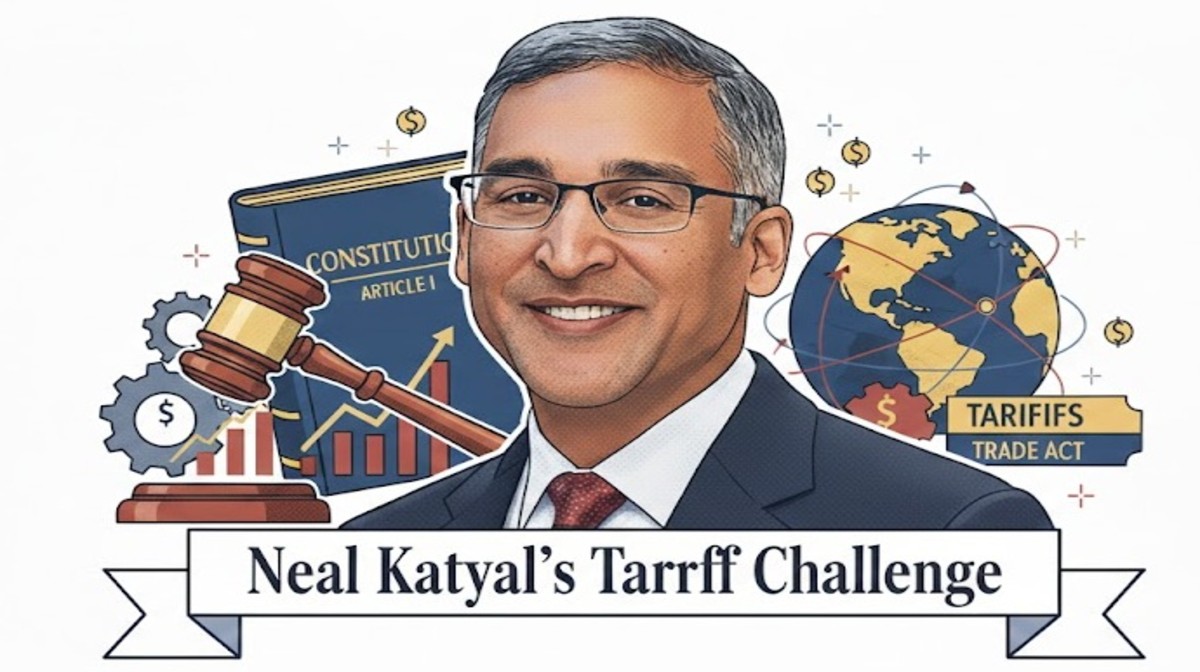
When former President Donald Trump invoked emergency economic powers to impose sweeping tariffs, the headlines focused on trade wars and global markets. Yet behind the numbers, a deeper constitutional struggle was unfolding. Neal Katyal, former Acting Solicitor General of the United States, became the leading voice arguing that the executive branch had gone too far.
Katyal’s challenge was not about whether tariffs were good or bad policy. It was about whether a president can bypass Congress and claim unilateral authority over taxation and commerce. His position was clear: the Constitution grants Congress—not the executive—the power to regulate international trade. Allowing presidents to stretch emergency statutes into open-ended tariff powers risks eroding the very balance of powers that anchors American democracy.
The administration leaned on laws like the International Emergency Economic Powers Act and Section 232 of the Trade Expansion Act, framing trade deficits as national security threats. Katyal countered that such interpretations transformed emergency powers into a blank check. He warned that if left unchecked, this precedent could weaken congressional oversight and concentrate economic authority in the presidency.
For businesses, the stakes were immediate. Sudden tariff hikes disrupted supply chains, raised costs, and forced price increases for consumers. Katyal’s legal strategy deliberately tied constitutional doctrine to these economic realities, showing how abstract questions of separation of powers translate into everyday consequences for American companies and households.
Critics noted that courts often defer to presidents on national security. But Katyal’s litigation pressed a vital question: should economic policy cloaked in “emergency” language escape scrutiny? His insistence that the judiciary test those boundaries underscored a broader truth — trade disputes can evolve into constitutional tests, and the courtroom can become the arena where presidential power is defined.
Katyal’s career has long been marked by cases probing executive authority. His tariff challenge fit squarely within that trajectory, reminding us that the Constitution is not a relic but a living safeguard against concentrated power. Whether one agrees with his trade views or not, his arguments illuminated a principle that transcends economics: in a democracy, even presidents must answer to law.
A Voice Shaped by Indian-American Roots
Born in Chicago in 1970 to immigrant parents from India, Neal Katyal has often spoken of his pride in being the son of immigrants. His father was a pediatrician and his mother a physician, instilling in him a respect for service and discipline. His sister, Sonia Katyal, is a noted law professor. Katyal studied at Dartmouth College and Yale Law School before rising to prominence in Washington. Today, he balances his distinguished legal career with teaching at Georgetown University Law Center, while also being a partner at Milbank LLP.
The tariff debate may fade, but the precedent Katyal pressed endures. His courtroom advocacy reminds us that economic governance is inseparable from constitutional governance — and that vigilance over executive power is not optional, but essential.
