
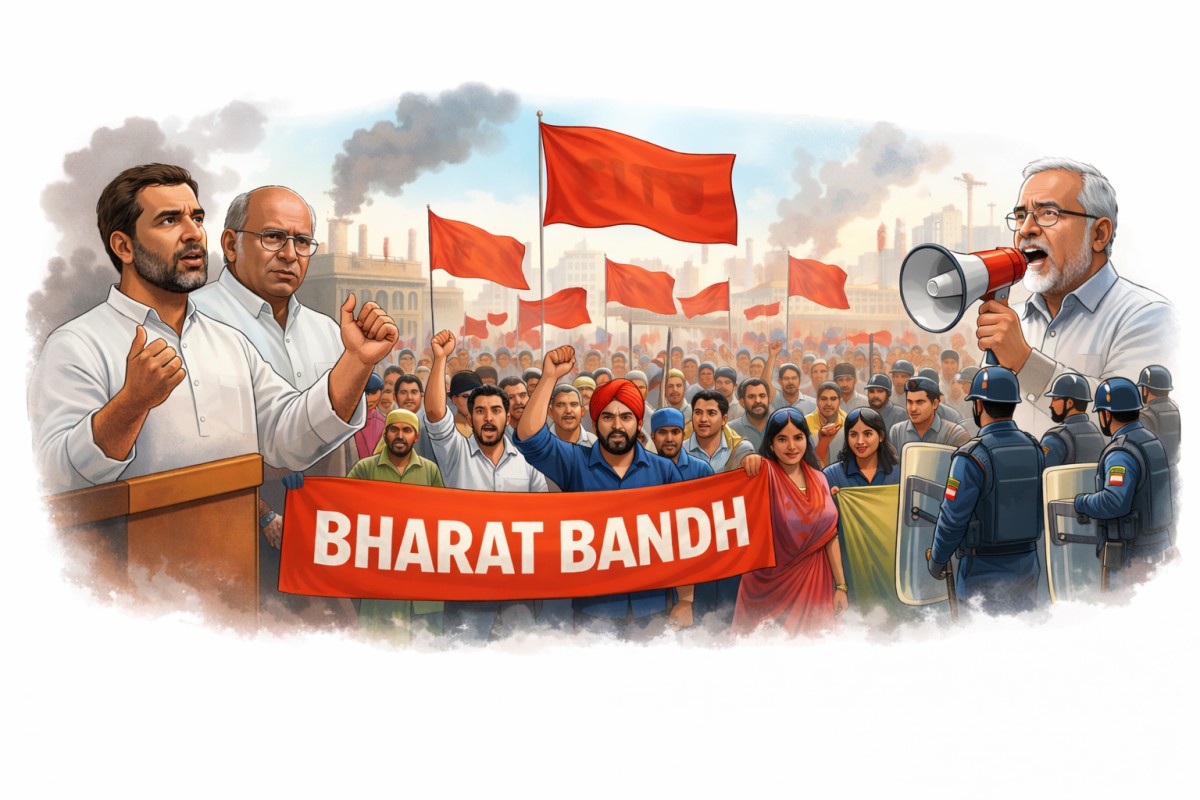
The above image is an illustrative representation, created with AI and does not depict actual individuals or events.
February 12, 2026, New Delhi : A coalition of central trade unions on Wednesday reiterated its call for a nationwide Bharat Bandh, drawing open political backing from the Congress party and sharpening the confrontation between labour groups and the Union government over economic and employment policies. Union leaders said the shutdown appeal is aimed at pressing for stronger worker protections, rollback of recent labour reforms, and relief measures for rising living costs.
Major union platforms stated that preparations are underway across several states, with outreach programs targeting industrial workers, transport staff, and public sector employees. Organisers claim the protest is intended to remain peaceful while demonstrating what they describe as widespread worker dissatisfaction.
CPI ML general secretary Dipankar Bhattacharya voiced support for the bandh, saying the mobilisation reflects deep economic stress among workers, farmers, and informal sector earners. He said the protest is meant to unite different sections affected by unemployment, wage pressure, and reduced social safeguards, and called for broad democratic participation.
Congress leader Rahul Gandhi expressed support for the agitation, saying that workers and small earners are facing sustained pressure due to price rise and job insecurity, and that their concerns deserve a democratic hearing. He stated that peaceful protest is a legitimate tool in a democracy and urged authorities to engage with labour representatives rather than dismiss their demands.
Congress president Mallikarjun Kharge also endorsed the bandh call, describing it as a reflection of ground level distress among workers and lower income groups. He said the government should open structured dialogue with unions and review policies that, in his words, weaken social security frameworks.
Government representatives have indicated that essential services will be maintained and have appealed for normal public activity, while monitoring arrangements are being coordinated with state administrations. The scale of participation is expected to vary by region, depending on local union strength and political alignment.
