
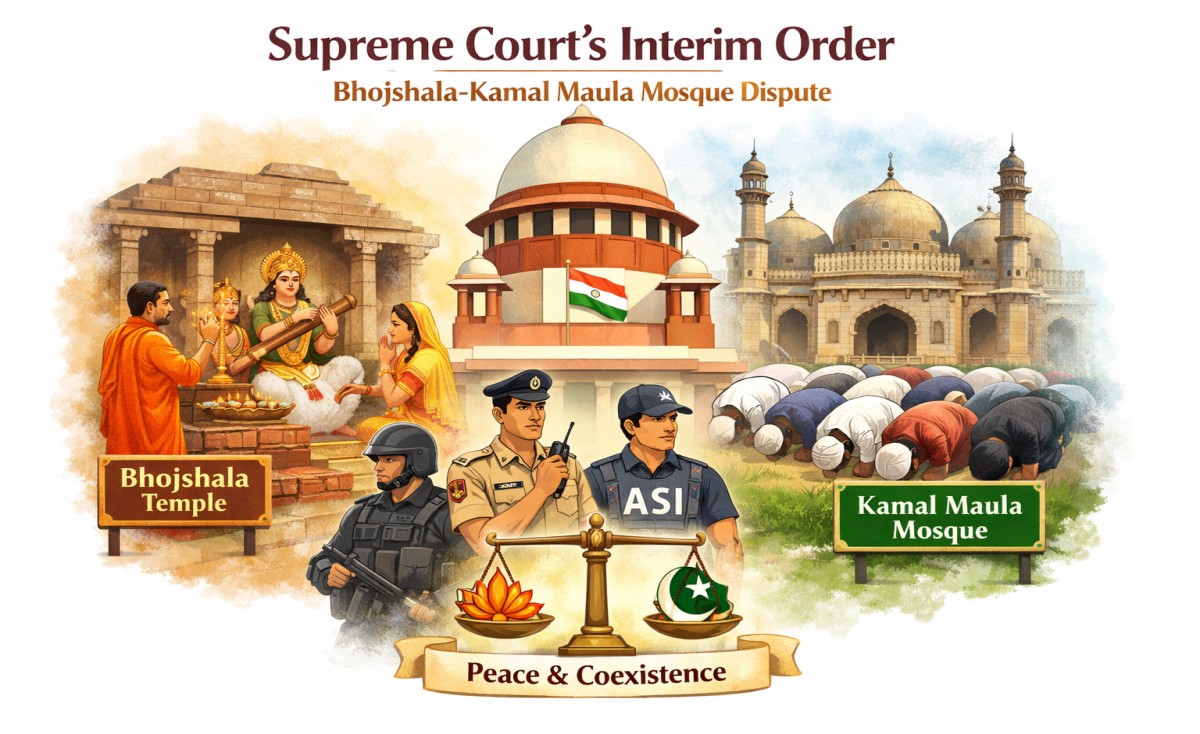
New Delhi, January 22, 2026 : The Supreme Court of India has issued a significant interim order concerning the long-standing dispute over the Bhojshala-Kamal Maula Mosque complex in Dhar, Madhya Pradesh. In a decision aimed at fostering peace and ensuring religious freedom, the apex court has permitted both Hindu and Muslim communities to conduct their respective prayers at the ancient site. This ruling comes amidst historical contentions surrounding the monument, which holds deep religious and cultural importance for followers of both faiths, particularly ahead of the auspicious occasion of Basant Panchami. The court’s directive emphasizes maintaining law and order while allowing an uninterrupted continuation of traditional practices.
The Supreme Court’s Interim Directive
The recent order by the Supreme Court of India marks a crucial development in the decades-old controversy surrounding the Bhojshala monument. The bench, comprising Justices Hrishikesh Roy and P.K. Mishra, passed an interim order allowing Hindus to offer prayers and perform rituals at the site on Basant Panchami. Simultaneously, the court affirmed the right of the Muslim community to conduct their Friday prayers at the Kamal Maula Mosque, located within the same complex. This balanced approach seeks to temporarily resolve the conflicting claims while the broader legal questions are still being deliberated.
The Supreme Court specifically instructed the district administration of Dhar to ensure the peaceful conduct of prayers for both communities. This includes the deployment of adequate security personnel and taking all necessary measures to prevent any untoward incidents. The order also mandates that the Archaeological Survey of India (ASI), which manages the site, facilitate necessary arrangements to accommodate the increased footfall during these religious observances, without disrupting the ongoing daily prayers of either community. The court’s emphasis on maintaining the status quo, while allowing specific prayer permissions, highlights its commitment to a judicious resolution that respects the religious sentiments of all parties involved.
Deciphering the Bhojshala-Kamal Maula Mosque Dispute
At the heart of the Supreme Court’s recent directive lies a complex historical and religious dispute over the Bhojshala-Kamal Maula Mosque. The site, located in Dhar district, Madhya Pradesh, is a protected monument under the ASI. Hindus believe the structure is a temple dedicated to Goddess Vagdevi (Saraswati) and a centre of learning established by the 11th-century Paramara king Bhoja, hence the name ‘Bhojshala’. They contend that it was originally a Saraswati temple which was later converted into a mosque.
Conversely, the Muslim community identifies the structure as the Kamal Maula Mosque and asserts its right to offer prayers there, pointing to its architectural features and historical records that suggest its use as a mosque over centuries. The ASI’s regulations currently permit Hindus to offer prayers on Basant Panchami and Tuesdays, while Muslims are allowed to offer prayers every Friday. This arrangement, however, has often been a source of tension, particularly when Basant Panchami falls on a Friday, leading to clashes over prayer timings and access. The present Supreme Court intervention directly addresses such potential overlaps, striving to create a framework for coexistence until a definitive judgment on the ownership and nature of the site is delivered.
Key Points
- The Supreme Court granted an interim order allowing both Hindu and Muslim communities to offer prayers at the Bhojshala-Kamal Maula Mosque complex.
- Hindus are permitted to conduct prayers and rituals on Basant Panchami, while Muslims are allowed to offer Friday prayers.
- The order emphasizes maintaining peace and order, with the Dhar district administration instructed to ensure smooth conduct of religious observances.
- The Archaeological Survey of India (ASI) manages the protected monument and must facilitate necessary arrangements for both communities.
- The dispute centers on whether the site is primarily a Saraswati temple (Bhojshala) or a mosque (Kamal Maula Mosque), with both communities asserting historical claims.
- This ruling aims to temporarily resolve conflicting claims, especially when Basant Panchami coincides with Friday prayers.
The Supreme Court’s interim order regarding the Bhojshala-Kamal Maula Mosque represents a significant step towards de-escalating tensions at a historically contentious site. By enabling both communities to observe their religious duties, the court has underlined the importance of religious harmony and the rule of law. While the larger legal battle over the site’s true nature and ownership continues, this decision provides a temporary framework for peaceful coexistence. The coming days will test the efficacy of this judicial intervention as local authorities work to implement the directives, ensuring that faith and tradition can flourish without conflict in the heart of Madhya Pradesh.
