
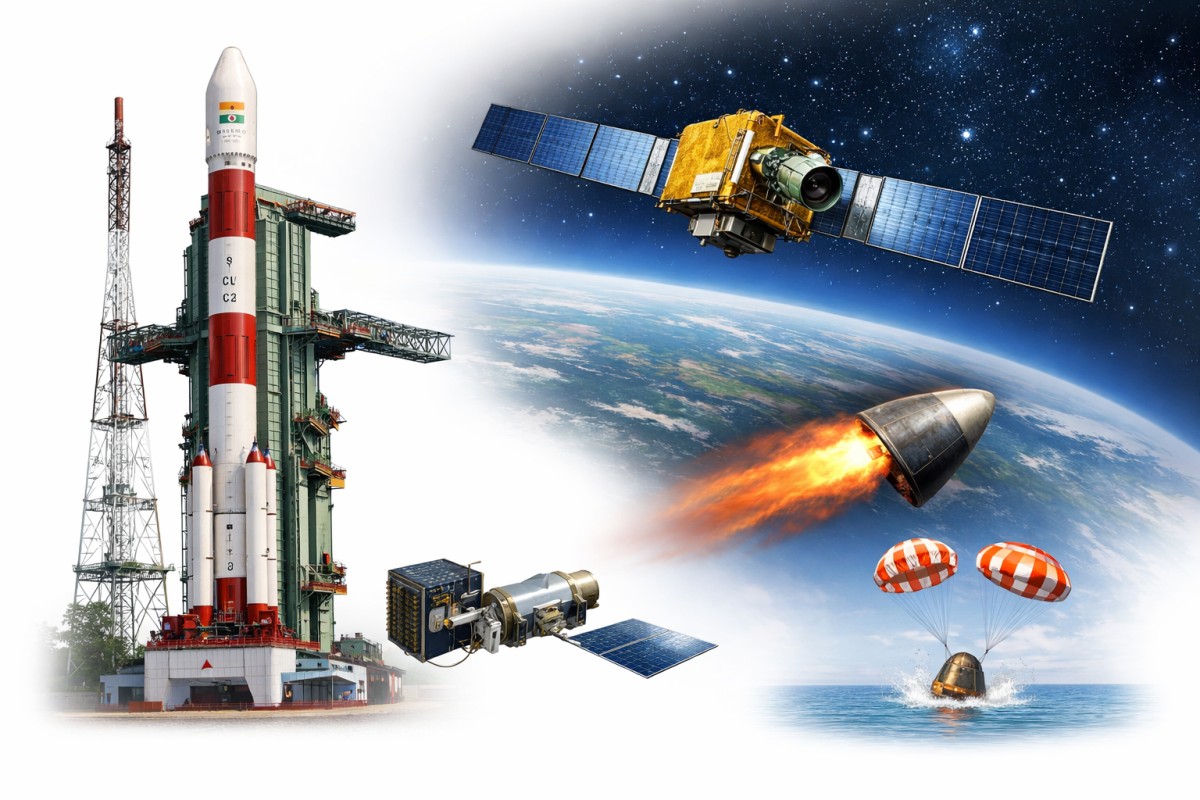
The Indian Space Research Organisation (ISRO) is set to begin its 2026 launch schedule with the liftoff of PSLV-C62, marking the agency’s first orbital mission of the year. The launch is scheduled for January 12, 2026, at 10:17 AM IST from the First Launch Pad at the Satish Dhawan Space Centre in Sriharikota.
This will be the 64th flight of the Polar Satellite Launch Vehicle, a platform that has become the backbone of India’s space programme due to its consistent reliability. The mission carries strategic, technological and commercial significance, reflecting ISRO’s evolving role as both a national capability builder and a global launch service provider.
The primary payload is EOS-N1 (Anvesha), an advanced hyperspectral Earth observation satellite developed with inputs from the Defence Research and Development Organisation (DRDO). Equipped with sensors capable of capturing data across numerous spectral bands beyond the visible range, EOS-N1 is expected to enhance India’s capabilities in terrain analysis, resource mapping and strategic surveillance.
Alongside the main satellite, PSLV-C62 will deploy a cluster of smaller co-passenger payloads. Among them is a technology demonstrator from Bengaluru-based space startup OrbitAID Aerospace, aimed at validating on-orbit servicing concepts such as satellite refuelling. If proven successful, such technologies could significantly extend spacecraft lifespans and reduce the accumulation of space debris.
Adding another layer of experimentation, the mission will also utilise the PSLV’s fourth stage as an orbital platform to host a re-entry technology demonstrator developed in collaboration with a European partner. The capsule is designed to test cost-effective recovery and re-entry systems, with a planned controlled splashdown in the Pacific Ocean after completing its objectives.
The PSLV-C62 launch sets the tone for a demanding start to the year for ISRO. The agency has outlined multiple missions for early 2026, including Earth observation satellites, technology validation flights and preparatory missions linked to the Gaganyaan human spaceflight programme. While timelines for those subsequent launches remain subject to technical readiness reviews, PSLV-C62 stands as the opening chapter of what is expected to be a closely watched year for India’s space ambitions.
By combining strategic observation, private-sector innovation and international collaboration in a single mission, ISRO’s first launch of 2026 underscores the breadth and maturity of India’s expanding space ecosystem.
