
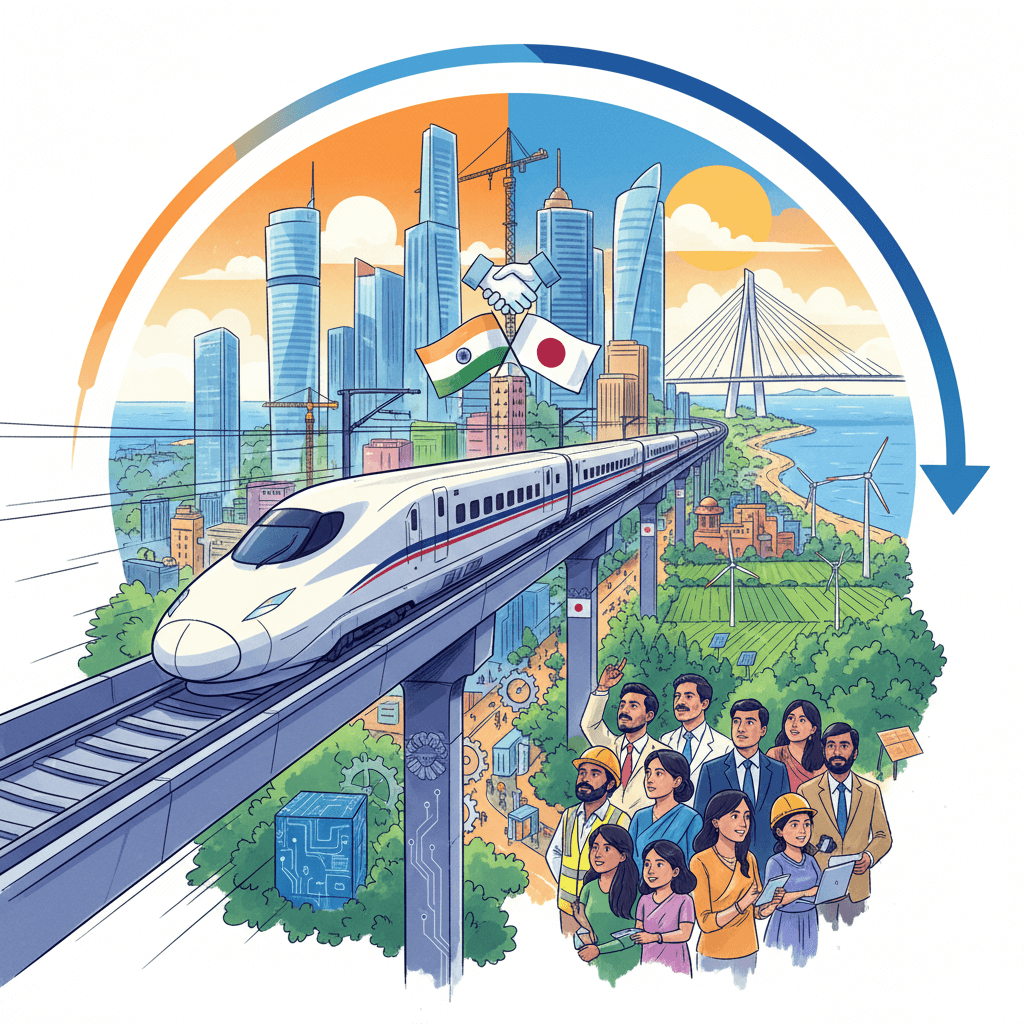
A Journey of Speed, Strategy, and Transformation
When India and Japan first signed the ambitious bullet train agreement in 2015, it symbolized far more than a transport project—it was a shared vision between two democracies seeking to marry technology, development, and diplomacy. Nearly a decade later, the Mumbai–Ahmedabad High-Speed Rail corridor (MAHSR) remains India’s most technologically advanced infrastructure project and one of its most debated. As construction gains renewed momentum, the project reflects both the potential and the growing pains of India’s modernisation story.
At its core, the MAHSR project spans roughly 508 kilometers, connecting Mumbai and Ahmedabad in just about two hours—less than one-third of the current travel time. Built on Japan’s world-renowned Shinkansen (bullet train) technology, the system promises safety, precision, and speed rarely seen in India’s transport ecosystem. Using the E5 Series Shinkansen as its model, the project aims for operating speeds up to 320 km/h and incorporates advanced earthquake-resistant systems, automatic train control, and specialized track design tailored to India’s terrain.
Japan’s Role and Partnership
The project’s foundation rests on deep Indo-Japanese cooperation. Japan is not only providing 81% of the project’s financing through a long-term soft loan (at a nominal interest rate of 0.1%) but also offering full-scale technical support, design expertise, and training. Japanese engineers and firms such as Hitachi and East Japan Railway (JR East) are working closely with India’s National High-Speed Rail Corporation Limited (NHSRCL). The project has also brought Japanese precision in project management, environmental safety, and construction standards into Indian infrastructure development for the first time at this scale.
This partnership represents a textbook example of economic diplomacy—Japan reinforcing its friendship with India while exporting its high-speed rail expertise, and India acquiring a globally tested system. Thousands of Indian engineers, technicians, and workers have already been trained under Indo-Japanese collaboration programs, fostering valuable knowledge transfer that will strengthen India’s future railway initiatives.
Economic Impact and Job Creation
The bullet train project has significant economic implications. During construction alone, it is estimated to generate around 90,000 direct and indirect jobs—ranging from engineering to logistics and hospitality. Once operational, it is expected to spur new economic corridors, boost tourism, and enhance real estate development along its route. Tier-II cities such as Boisar, Vapi, Bilimora, and Anand etc are expected to witness urban growth similar to what Japan experienced along its Shinkansen routes in the 1970s and 1980s.
Beyond employment, the bullet train has multiplier effects—creating demand for domestic steel, cement, electrical equipment, and signaling systems, all of which contribute to industrial and regional development.
Challenges and Delays
Despite its promise, the project has not been without challenges. Land acquisition—particularly in Maharashtra—has been the biggest hurdle, delaying progress for years. While Gujarat achieved over 95% land acquisition early on, Maharashtra’s portion lagged due to political and local opposition. Environmental clearances, alignment revisions, and the COVID-19 pandemic further slowed execution.
As a result, the initial target of 2023 for full operation was missed, and the revised plan now points to a partial launch between Surat and Bilimora by 2027. Naturally, each year of delay has cost implications. The project’s initial estimate of INR 1.08 lakh crore has been revised to INR 1.65 lakh crore, with projections suggesting that the final expenditure could approach INR 2 lakh crore. Despite the sharp escalation driven by inflation, material costs, and currency fluctuations, both governments continue to view the initiative as a landmark symbol of Indo-Japanese partnership rather than merely a transport infrastructure project.
Global Context:
India’s high-speed rail ambitions are unfolding as the world reassesses the economics of such mega projects. Japan’s own Shinkansen remains a benchmark for safety and efficiency, but even in advanced economies, cost and complexity remain universal challenges.
In the United States, for example, the proposed high-speed line between San Francisco and Los Angeles has ballooned from $33 billion to over $120 billion, leading to partial rollbacks and delays. A similar Texas project between Dallas and Houston, planned with Japanese partners, has seen costs rise from $12 billion to over $40 billion.
Europe’s high-speed networks, such as France’s TGV and Spain’s AVE, continue to operate successfully, but their expansion has slowed due to economic constraints. Meanwhile, China—currently the undisputed leader with over 40,000 km of operational high-speed lines—demonstrates how state-backed investment can accelerate such projects, though often without the democratic and environmental checks India must adhere to.
Australia, too, has entered the high-speed rail conversation, with its government recently establishing a dedicated authority to explore a Sydney–Newcastle line aimed at cutting travel time and reducing emissions.
A Catalyst for Growth and Modernization
For India, the bullet train is more than a technological leap—it’s a psychological one. It challenges the nation’s comfort with “good enough” infrastructure and sets a benchmark for precision and discipline. The project embodies the belief that connectivity fuels progress—connecting not just cities but aspirations, economies, and people.
Equally significant is its environmental promise. By shifting a substantial share of passenger traffic from road and air to rail, the bullet train is expected to reduce carbon emissions, fuel consumption, and congestion, contributing to India’s broader commitment to sustainable development. The adoption of energy-efficient systems and the use of green construction practices further underscore the project’s potential as a model for eco-conscious infrastructure.
Yet the real test lies ahead. India must balance ambition with execution, ensuring cost discipline, environmental protection, and timely delivery. If done right, the Mumbai–Ahmedabad bullet train could redefine intercity mobility in India and mark the beginning of a new era of sustainable, high-speed connectivity.
In the words of Achal Khare, former Managing Director of NHSRCL, “High-speed rail is not just about reducing travel time—it’s about changing the way India thinks about growth.”
The whistle may not have sounded yet, but the direction is unmistakable. India’s bullet train is more than an engineering project—it is a symbol of a nation racing towards the future—swift, sustainable, and self-assured—at 320 kilometers per hour.
