
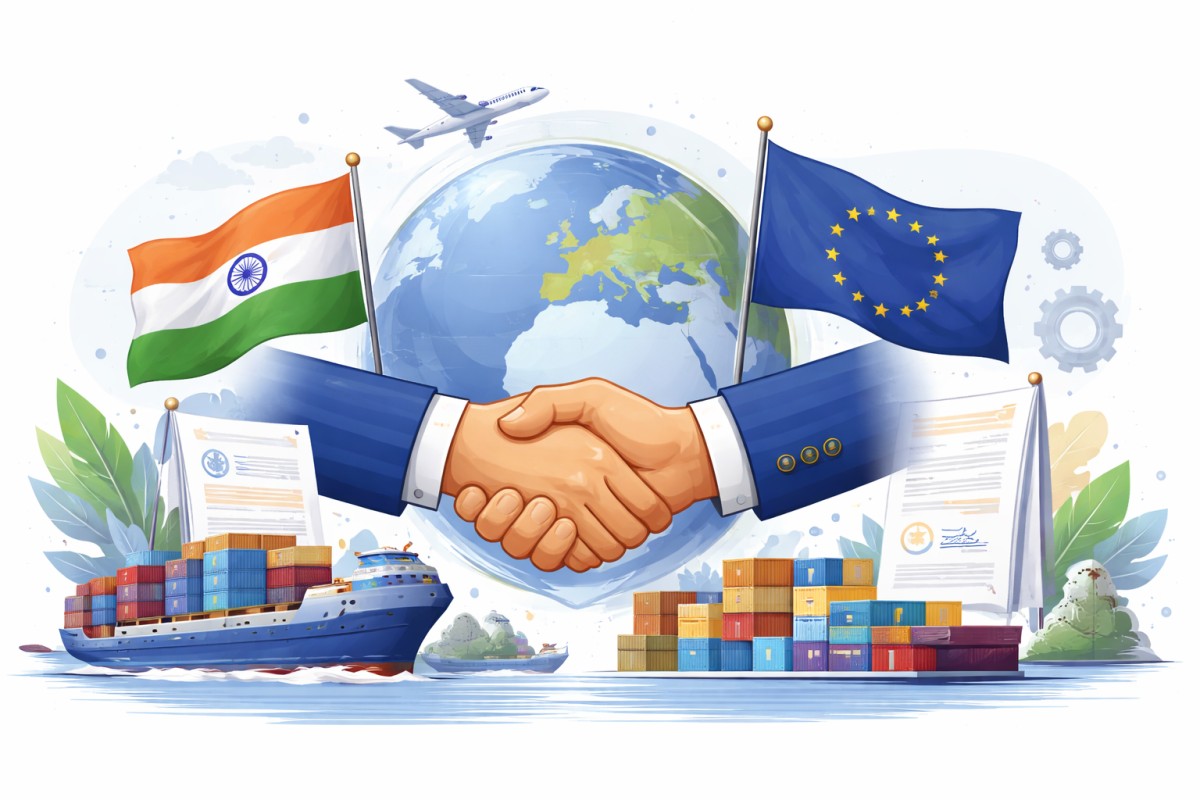
New Delhi, January 20, 2026 : India and the European Union are close to concluding a long-pending free trade agreement that both sides describe as one of the most ambitious economic pacts negotiated in recent years, even as global trade faces renewed uncertainty from possible tariff actions by the United States.
Speaking at the World Economic Forum annual meeting, Ursula von der Leyen, President of the European Commission, said negotiations with India had reached a decisive stage. The proposed agreement, often referred to by European leaders as the “mother of all deals,” is expected to create a combined market of nearly two billion people, accounting for roughly a quarter of global economic output.
Von der Leyen indicated that while technical work remains, both sides are moving towards a political conclusion. She confirmed plans to travel to India shortly after the Davos meetings, underscoring the urgency being attached to finalising the pact. According to her, the agreement would give European businesses early access to one of the world’s fastest-growing major economies, while strengthening India’s links with European markets, technology and capital.
The talks are unfolding against a backdrop of global trade disruptions and concerns over Washington’s tariff policies. European officials have signalled that deeper engagement with India is part of a broader strategy to diversify trade partnerships and reduce over-reliance on the US market.
Trade between India and the European Union already stands at significant levels. The EU is India’s largest trading partner, with bilateral goods trade valued at about 135 billion US dollars in the 2023–24 financial year. Officials on both sides believe the free trade agreement could substantially expand this figure over the coming decade.
Beyond commerce, the expected summit in India later this month is likely to deliver a broader strategic package. In addition to the trade deal, New Delhi and Brussels are preparing to announce a defence cooperation framework and a long-term strategic roadmap covering the period from 2026 to 2030. Negotiations are also set to begin on a Security of Information Agreement, aimed at boosting industrial and defence collaboration.
The visit of von der Leyen and Antonio Costa, President of the European Council, to India from January 25 to 27 will coincide with Republic Day celebrations. The two leaders are expected to hold summit-level talks with Prime Minister Narendra Modi, where the conclusion of negotiations could be formally announced.
India and the European Union have been strategic partners since 2004. Negotiations for a free trade agreement were first launched in 2007 but stalled in 2013 due to differences over market access, tariffs and regulatory issues. Their revival and near-completion now reflect shifting global economic realities and a shared interest in closer political, economic and security cooperation.
