
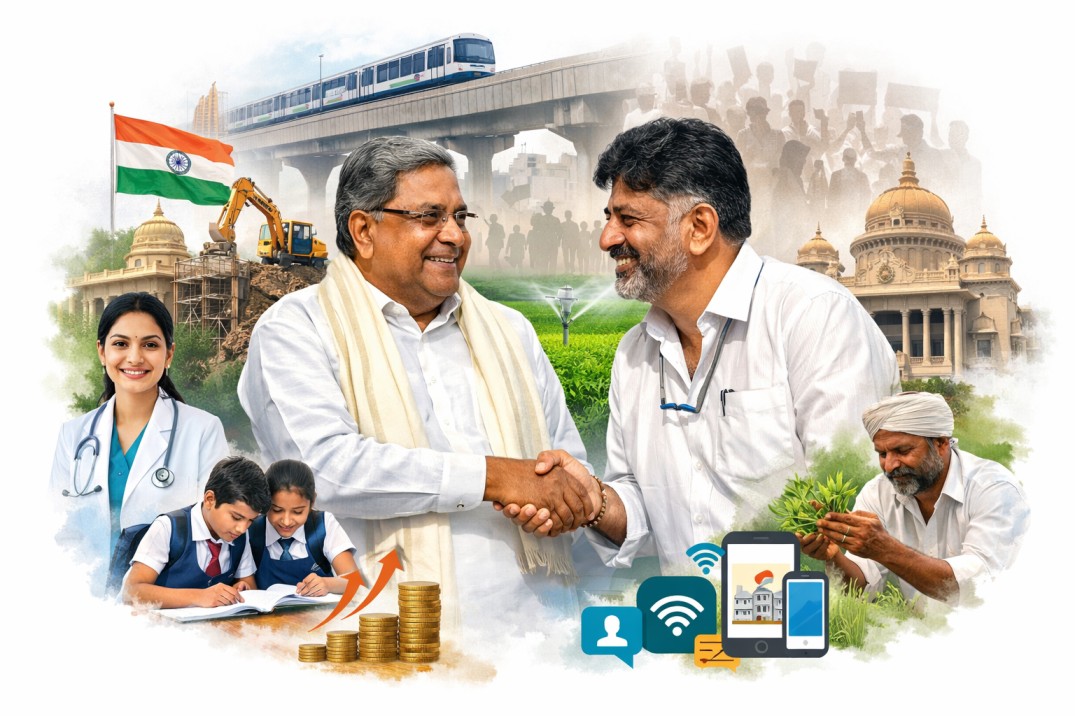
Karnataka Chief Minister Siddaramaiah on Tuesday reiterated that his government is firmly positioned to complete its full five-year tenure, downplaying speculation arising from recent political turbulence in the state. His assertion was reinforced by Deputy Chief Minister D. K. Shivakumar, who met him briefly and conveyed his support as the administration moves into a critical phase of governance.
The comments come against a backdrop of heightened political activity, with the ruling Indian National Congress dealing with internal differences and sustained pressure from opposition parties. In recent months, defections, public protests, and policy debates have intensified scrutiny over the stability of the government in Karnataka.
Siddaramaiah, however, maintained that his focus remains squarely on delivery rather than political speculation. He cited progress on several commitments made during the 2023 Assembly elections, particularly in education, healthcare, and rural development. According to him, initiatives such as the expansion of rural health facilities and targeted education programmes reflect steady movement on the government’s core agenda.
During the meeting at the state secretariat, Shivakumar, who also holds the finance portfolio, offered a succinct message of encouragement and emphasised collective responsibility within the leadership. He also addressed concerns over the state’s finances, stating that fiscal management remains on track and that forthcoming reforms are intended to strengthen revenues without undermining welfare schemes.
Looking ahead, the government has identified infrastructure development, agricultural support, and digital governance as its principal focus areas for the remainder of the term. These initiatives are expected to be funded through a combination of central assistance, public-private partnerships, and calibrated tax measures aimed at broadening the base while shielding lower-income groups.
Political observers have offered mixed assessments. While some view the leadership’s statements as a credible signal of unity, others caution that upcoming local elections could reshape political dynamics and test the government’s cohesion. Public opinion also appears divided, balancing optimism about continuity with concerns over persistent challenges such as water stress and youth unemployment.
For now, the messaging from Siddaramaiah and Shivakumar projects confidence and an intention to maintain momentum, even as Karnataka navigates a complex political and economic landscape.
