
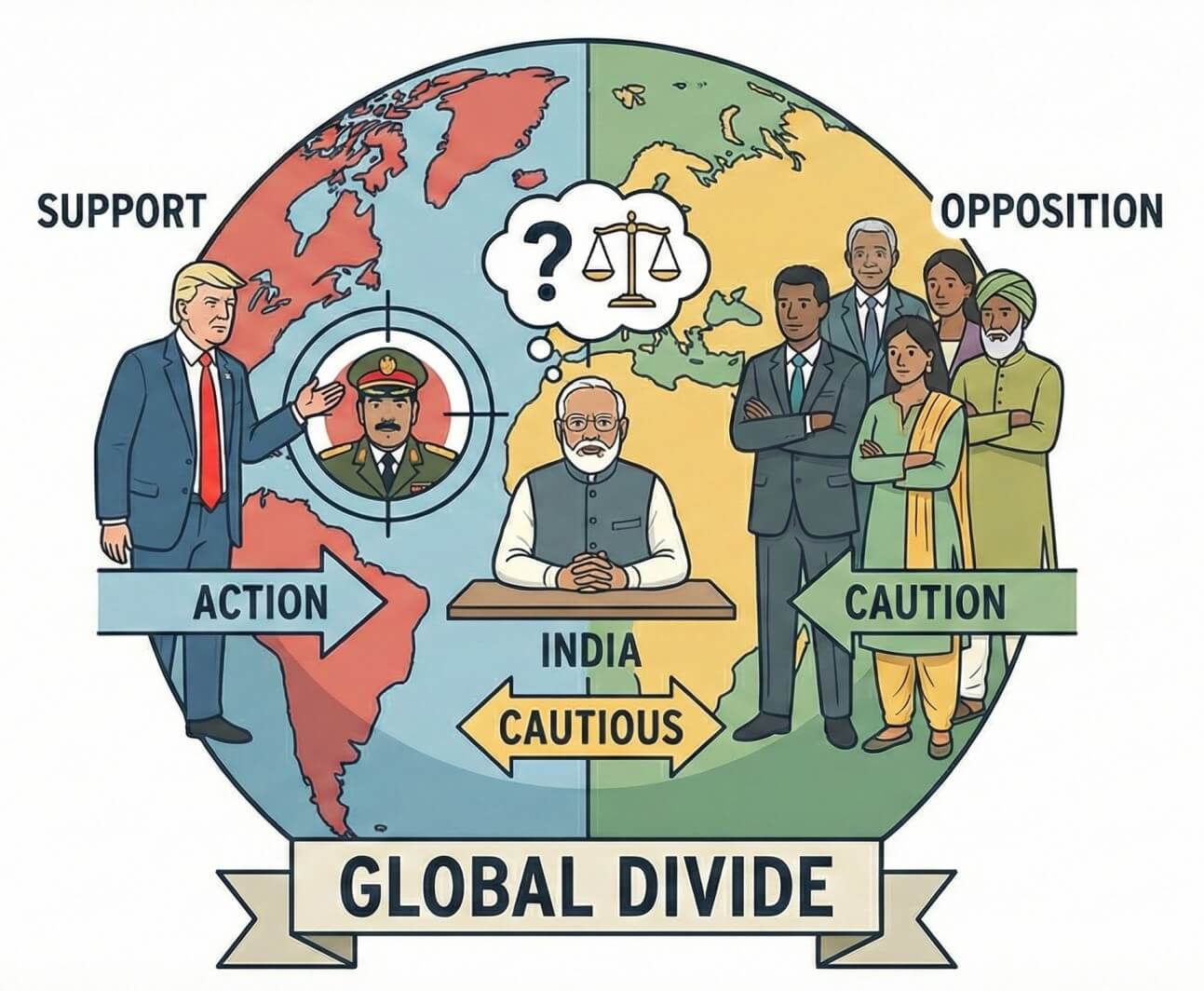
President Donald Trump’s recent airstrike against Venezuelan leader Nicolás Maduro’s forces has ignited a polarized response worldwide. While some governments and analysts praise the action as a decisive move against a perceived threat, others condemn it as a violation of international norms. In this climate of divergent opinions, India’s prime minister, Narendra Modi, has chosen a measured diplomatic approach, avoiding overt endorsement or criticism.
International reactions to the strike
The United States framed the operation as a necessary response to alleged aggression by Maduro’s regime, citing intelligence that suggested a direct threat to U.S. interests. Allies such as Israel and certain European nations expressed support, emphasizing the need to counter authoritarian behavior in the region.
Conversely, countries including Russia, China, and several Latin American states denounced the strike, calling it an unlawful breach of Venezuelan sovereignty. The United Nations called for an urgent meeting to discuss the implications for regional stability and the precedent it sets for future interventions.
India’s diplomatic positioning
India, traditionally maintaining a non‑aligned stance, has refrained from joining the chorus of either condemnation or praise. Prime Minister Modi’s administration issued a brief statement underscoring the importance of respecting international law and encouraging dialogue between the United States and Venezuela.
Analysts note that India’s careful wording reflects broader strategic considerations. Maintaining strong trade ties with both the United States and Latin American markets, while also preserving relationships with Russia and China, requires a balanced approach. Additionally, India’s own regional interests in the Indo‑Pacific demand a consistent policy of non‑intervention.
As the global community continues to assess the ramifications of the strike, India’s cautious diplomatic posture underscores its broader foreign‑policy principle of strategic autonomy. The evolving discourse will likely shape how nations navigate similar conflicts in an increasingly multipolar world.
