
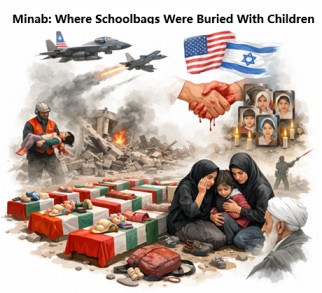
The above image is an illustrative representation, created with AI and does not depict actual individuals or events.
Small coffins, empty desks, and unanswered questions.War often produces statistics. But sometimes those statistics have names, schoolbags, empty desks and unfinished homework.
On 28 February 2026, a missile strike destroyed the Shajareh Tayyebeh girls’ elementary school in Minab, southern Iran. Reports indicate that between 150 and 180 people were killed; the majority of them schoolgirls aged roughly seven to twelve who were present during the school day.
The attack occurred during the opening phase of the United States–Israel military offensive against Iran. Footage verified by multiple international outlets showed the building reduced to rubble, with rescue workers pulling children’s backpacks and bodies from the debris.
Across Iran, thousands gathered in Minab to mourn the young victims. Rows of small coffins and photographs of children became the haunting symbols of the tragedy.
Officials in Washington insist that civilian sites are not deliberately targeted and say the incident is under investigation.
Yet the questions raised by the bombing cannot be delayed until the guns fall silent.
Because those who died were not soldiers. They were children.
Questions the World Cannot Avoid
If nearly two hundred schoolgirls can be killed in a single strike during a modern military campaign, what exactly remains of the global promise to protect children in conflict?
Where are the voices of the international human rights organisations that frequently speak about justice, accountability, and the protection of civilians?
Where are the global children’s rights bodies that issue statements whenever violence occurs elsewhere in the world?
And perhaps the most uncomfortable question of all: will the international system apply the same standards of accountability to powerful states as it does to weaker ones?
The international order frequently invokes sanctions as a tool of moral pressure. Nations are sanctioned for alleged human rights violations, elections are scrutinised, and governments are isolated for civilian casualties.
But will the same mechanism ever be used against those accused of causing the deaths of hundreds of children in a foreign country?
Or will geopolitical power once again determine which tragedies are condemned and which are quietly investigated and forgotten?
The Moral Test of Global Institutions
International humanitarian law is clear in principle. Schools are civilian structures. Children are protected persons. Attacks that cause disproportionate civilian casualties must be investigated and accountability ensured.
In practice, however, enforcement depends on political will.
The United Nations has already called for an independent investigation into the Minab school strike.
But investigations alone cannot answer the deeper moral question.
If a state or coalition is found responsible for the deaths of hundreds of schoolchildren, will the world impose consequences?
Will sanctions be considered?
Will international courts pursue responsibility?
Or will the tragedy simply become another footnote in the long history of wars where civilian suffering is acknowledged but rarely punished?
The Dangerous Cycle of Blame
There is another troubling dimension to this conflict.
As Iran launches retaliatory attacks and the war escalates across the region, narratives will inevitably shift. Each side will accuse the other of atrocities. Each will justify its actions as necessary defence.
In such circumstances, the truth becomes vulnerable to manipulation.
If further civilian tragedies occur in areas struck by Iranian retaliation, will the global narrative automatically attribute blame to Tehran alone?
Or will the earlier events — including the destruction of a school full of children — remain part of the moral equation?
Selective outrage has long been one of the most damaging features of international politics.
When the deaths of children become subject to geopolitical alignment rather than universal compassion, the credibility of the entire human rights system begins to erode.
The Real Question
At the centre of the Minab tragedy lies a question that extends far beyond Iran, Israel, or the United States.
Are the lives of children equal in the eyes of the international community?
If the answer is yes, then the deaths of schoolgirls in Minab must trigger the same global outrage, legal scrutiny, and accountability demanded anywhere else.
If the answer is no, then the world must admit something far more troubling: that the protection of children in war is not a universal principle, but a selective one.
And if that is the case, the real casualty of this war may not only be the children of Minab — but the credibility of the entire international human rights system.

Very pertinent questions..