
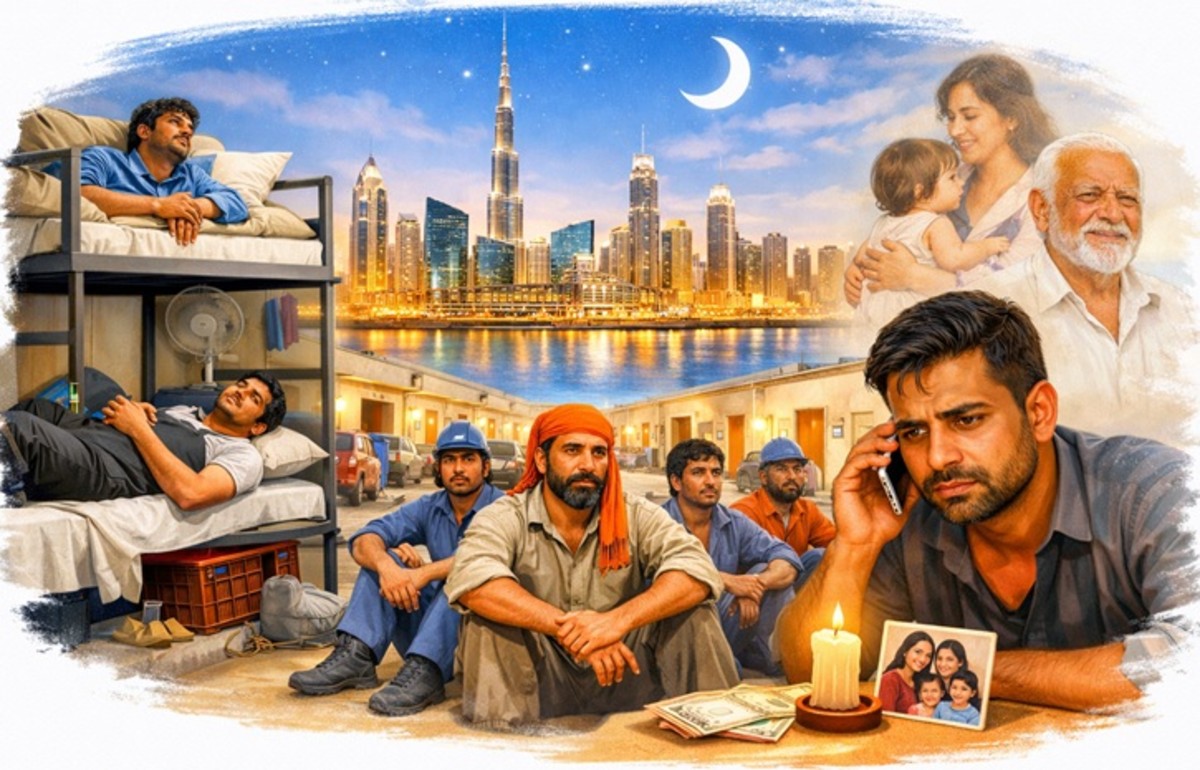
Dubai’s skyline glitters each night like a proclamation of triumph, its towers piercing the desert sky with an almost unshakable certainty. Yet beneath that brilliance, another truth gathers quietly in the shadows — inside labour camps, cramped rented rooms, and industrial quarters where thousands lie awake, listening not to the hum of the city but to the silence of their own unanswered hopes. These are the migrant workers, drawn from India, Pakistan, Bangladesh, Nepal, and across Africa and the Middle East, whose monthly wages often carry the weight of entire households back home. For them, Dubai was never just a workplace; it was a fragile promise, stitched together call by call, sacrifice by sacrifice, a dream sustained across oceans. “Back home, many dreams breathe through one earning hand,” a worker whispered — a reminder that beneath the city’s dazzling lights, countless lives flicker with uncertainty, waiting for tomorrow’s answer.
For many of them, the sound of a siren has begun to mean more than caution. It is a sudden reminder that war, even when fought across borders, does not always stay where maps expect it to remain. In recent days, as tensions linked to the regional conflict involving Iran, Israel and the United States have intensified; falling debris and intercepted aerial strikes have turned distant geopolitical decisions into something painfully immediate for ordinary workers whose lives are already balanced on narrow margins.
In the outer edges of the city, where buses leave before sunrise carrying construction workers, drivers, cleaners and mechanics toward long shifts, conversations have changed. Men who once spoke about overtime wages, exchange rates and tickets home now ask one another whether the night sky sounded different, whether the sirens were closer, whether families back home have seen the news.
A young transport worker, who had spent years saving every possible dirham for his wife and children in South Asia, became one of the lives claimed when fragments from an intercepted strike struck his vehicle. He had been planning to return home next year with enough savings to begin building a permanent house. Relatives say he often spoke of a roof of his own, saying that “a rented life should not become the children’s inheritance.” That unfinished dream now survives only in words remembered by those who shared a room with him.
His death has travelled faster than any official explanation. In worker accommodations, where grief is often shared silently because everyone fears being the next name carried home in a sealed coffin, the story has spread from room to room.
“He used to count months, not years,” one fellow worker said quietly. “Every month meant school fees paid, medicine bought, one more brick for the future. Now even that counting has stopped.”
Across industrial districts, fear does not always appear dramatic. It appears in men checking their phones repeatedly during lunch breaks, in calls made home before sleeping, in workers stepping outside to look at the sky after hearing aircraft overhead.
A cleaner employed in a commercial district described the atmosphere simply: “The city still looks normal, but inside people are carrying questions they cannot ask loudly.”
For many migrant workers, leaving is not a practical option. Air tickets are expensive, contracts remain active, and salaries are often committed in advance to debts, family expenses or loans taken years earlier to secure employment abroad. Home, for many, is not immediately safer because home also means unpaid obligations waiting at the door.
Some workers admit that fear and helplessness now live side by side. “If I stop working, my family suffers immediately,” said one delivery worker. “If I stay, I do not know what tomorrow brings. Either way, worry follows.”
Markets in older parts of the city have also begun to feel the strain. Fish sellers report thinner arrivals and unpredictable prices. Imported goods are reaching shelves more slowly. Shopkeepers who once relied on steady movement now sit through long quiet hours, watching fewer customers pass through narrow lanes.
One trader compared the present atmosphere to “a clock still moving, but with every sound louder than before.”
In hospitality areas too, caution has entered daily business. Restaurants near the coast report cancellations reduced evening crowds and shorter reservations. Some establishments have already adjusted staffing because footfall no longer matches usual expectations. Workers employed there say uncertainty now travels with every shift.
Yet even under tension, life continues because it must. Buses still depart before dawn. Uniforms are ironed. Lunch boxes are packed. Video calls home are made between shifts. Salaries are calculated with precision because every dirham still carries meaning far beyond the city.
For many of those who arrived in Dubai years ago, the city became more than employment. It became a place where sacrifice slowly took shape into purpose. Every long day carried an invisible promise: a child’s education, a parent’s medicine, a small house, a repaired roof, a debt finally cleared.
That is why fear here feels different. It is not only fear of danger. It is fear that years of patient struggle may be interrupted before reaching their destination.
As sirens return to the Gulf sky, the towers remain lit, traffic still moves, and the city outwardly keeps its rhythm. But in the labour quarters beyond the postcard image, many now sleep lightly, listening not only for alarms, but for reassurance that morning will still arrive carrying work, wages and one more ordinary day.
For those who built their hopes brick by brick in a foreign land, even ordinary days have become precious.
