
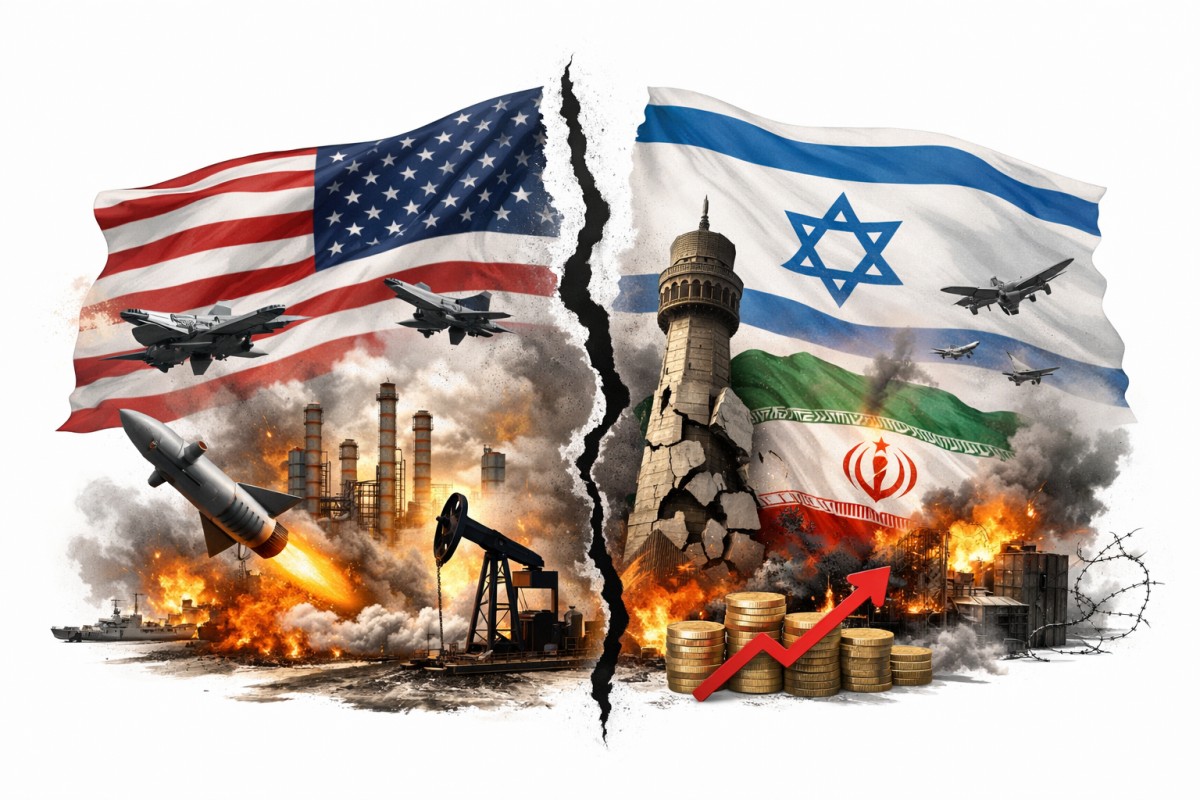
History often records alliances as fixed, yet in reality they evolve—shaped by risk, recalibrated by circumstance, and occasionally strained by differing visions of victory. The ongoing conflict surrounding Iran has brought such a moment into focus, revealing a subtle but meaningful divergence between the United States and Israel. Both remain aligned in identifying Iran as a central strategic challenge, yet their approaches increasingly reflect different philosophies of power, restraint, and endgame.
This divergence is not about the threat itself, but about the scale of response. Washington’s posture suggests a deliberate attempt to operate within limits. The United States appears focused on degrading Iran’s missile capabilities and regional proxy networks while avoiding a broader conflict that could destabilize the Middle East or disrupt global markets. It is a strategy of management rather than transformation—contain the threat, limit escalation, and preserve diplomatic space.
Israel’s approach, by contrast, reflects a deeper sense of urgency. Its actions suggest a willingness to move beyond containment toward systemic weakening of Iran’s leadership. Critical infrastructure and economic lifelines have increasingly become targets. The underlying belief appears to be that partial measures only prolong the threat, and that a decisive outcome—despite risks—is preferable to indefinite containment.
Such differences are not new. During the Vietnam War, the United States operated alongside South Vietnam, supported by a broader coalition that included South Korea, Australia, and Thailand. Despite this alignment, cracks emerged over time as the limits of incremental escalation became evident and the human and political costs mounted.
The Iraq War presented a different but equally instructive case: a U.S.-led coalition, most notably with the United Kingdom, undertook a regime-change mission that initially achieved swift military success, but later revealed the profound risks of entering conflict without a clearly defined and sustainable post-war framework.
In Afghanistan, the United States was joined by a wide NATO alliance, invoking collective defense and sustaining one of the longest multinational military engagements in modern history. Yet, despite two decades of coordinated effort, the outcome underscored a sobering reality—that battlefield dominance does not automatically translate into durable political stability.
Across these conflicts, one pattern stands out with striking clarity: alliances may share immediate objectives and operate under a unified command structure, but their tolerance for risk, timelines for engagement, and definitions of “victory” often diverge over time. It is in this gradual divergence—quiet at first, but consequential in the long run—that the true complexity of coalition warfare reveals itself.
That divergence is now visible in operational decisions. A recent strike on a major Iranian gas facility—known to Washington but not publicly endorsed—highlighted this gap. The aftermath was immediate: Iranian retaliation and volatility in global energy markets. What appeared tactically effective carried broader strategic consequences.
Within the United States, this has triggered unease. Some policymakers question whether long-term American interests are being overshadowed by alliance dynamics. The resignation of a senior counterterrorism official underscores that these concerns are not merely theoretical, but deeply consequential.
On the ground, the costs continue to rise. Airstrikes and counterstrikes have become routine, with civilians often bearing the burden. Infrastructure damage and rising energy prices are rippling beyond the region, reinforcing how modern conflicts rarely remain contained.
Perhaps most striking is the absence of a clear endpoint. Military actions continue, progress is claimed, yet the path to resolution remains uncertain. Will pressure weaken Iran internally, or strengthen its resolve? Can escalation remain controlled, or will it cross irreversible thresholds?
These are not purely strategic questions—they carry a quiet human weight. Behind every decision lies an awareness of lives affected, even if distant from the centers of power.
For the United States, the challenge is balancing strength with restraint. For Israel, the priority appears to be decisive resolution rather than prolonged management. Both perspectives are shaped by history and national experience—and both carry internal logic.
The larger question is whether these paths can continue without eventually clashing. Alliances endure when not only goals but assumptions align. When those begin to diverge, even subtly, the consequences grow over time.
As events unfold, the world watches both the battlefield and the decision-making behind it. The future of this conflict will depend not just on military strength, but on whether differing visions can be reconciled into a coherent strategy.
In the end, wars are defined not only by outcomes, but by how they conclude—and at what cost. Even among close allies, the road to that conclusion is rarely the same.

Very apt analysis – from another angle