
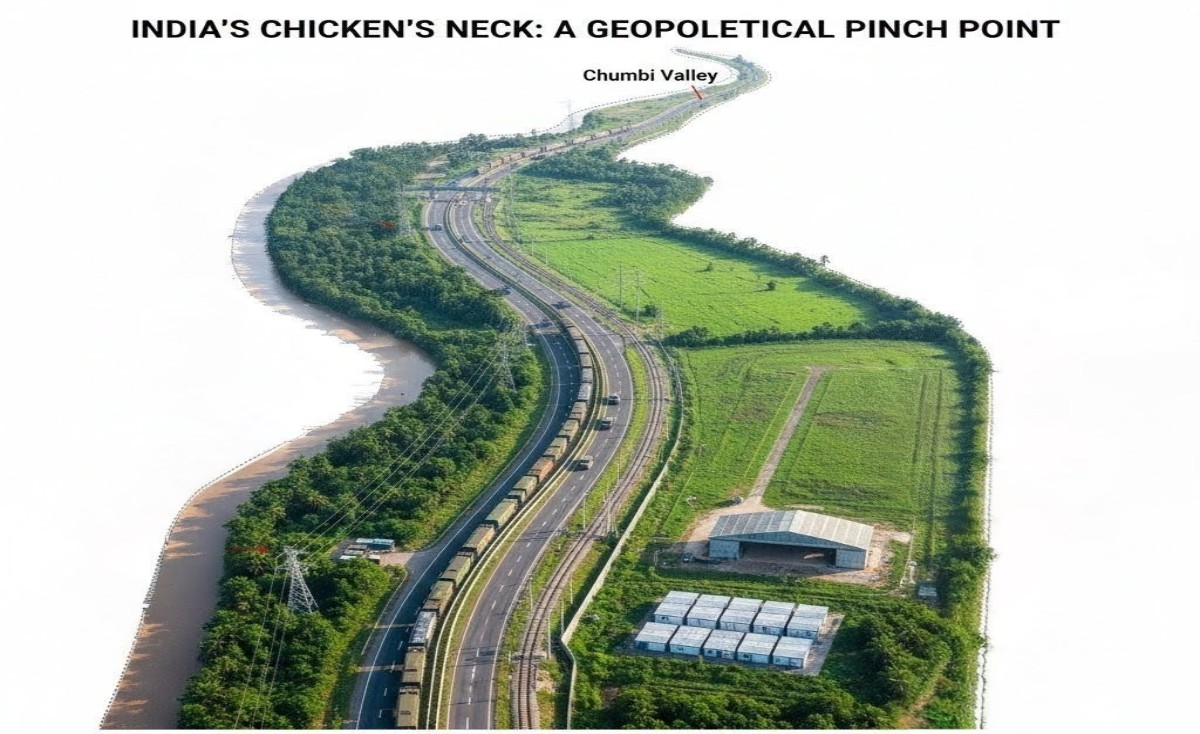
New Delhi | January 23, 2026 : Indian security and strategic planners are closely tracking developments in the eastern subcontinent amid reports of renewed infrastructure activity near the Siliguri Corridor, the narrow stretch of land linking mainland India with its eight northeastern states.
Often referred to as the “Chicken’s Neck,” the corridor is barely 20 to 22 kilometers wide at its narrowest point. It carries the vital road, rail, fuel, and communication links that sustain India’s Northeast. Any disruption in this passage is viewed as having catastrophic economic and military consequences, making even incremental changes in the surrounding region a matter of national priority in New Delhi.
The Lalmonirhat Airbase Factor
Attention has recently turned to developments in northern Bangladesh’s Rangpur division, where efforts are underway to revive and upgrade the Lalmonirhat Airport. This WWII-era airstrip is located within operational proximity of the Siliguri Corridor, sitting a mere 15 to 20 kilometers from the Indian border.
While these initiatives are officially described as civilian development, the involvement of Chinese technical teams in reviving the airfield has prompted Indian agencies to assess potential “dual-use” implications. The ability to station or monitor aerial assets so close to the corridor would significantly reduce India’s reaction time in a conflict scenario.
The Teesta Master Plan and ‘Economic Zones’
The unease has been compounded by the growing Chinese diplomatic and technical footprint in the Teesta River Comprehensive Management and Restoration Project. Following high-profile visits by Chinese officials to the region, including Ambassador Yao Wen, New Delhi is monitoring the creation of “economic zones” along the river.
Indian analysts note that such involvement is part of a broader pattern of China’s expanding footprint. The presence of large numbers of Chinese personnel and technical assets in the Rangpur division—directly adjacent to the Siliguri Corridor—is seen as a strategic move to alter the regional security calculus under the guise of infrastructure development.
India’s Multi-Layered Defense Response
In parallel, India has aggressively strengthened its own position. Security agencies have invested in the “Permanent Defensive Infrastructure” (PDI) and enhanced the logistics hubs of the Tri-Shakti Corps. Specific measures include:
New Military Garrisons: The operationalization of new stations at Kishanganj (Bihar) and Chopra (West Bengal) to provide immediate depth to the corridor.
Alternative Connectivity: Accelerated work on the Multi-Modal Transit Transport Project to ensure that India’s Northeast remains accessible even if the Siliguri land bridge is stressed.
Infrastructure Hardening: Improved troop mobilization capabilities and the deployment of advanced surveillance assets along the border to monitor cross-border activity in real-time.
Geopolitical Outlook
Diplomatically, India is seeking to manage the situation through a calibrated mix of vigilance and engagement with the interim administration in Dhaka. However, with the approach of regional elections and the visible shift in Chinese technical presence, the Siliguri Corridor remains a stark reminder of how geography and infrastructure intersect. For New Delhi, developments even a few kilometers beyond the border now carry disproportionate strategic weight.
