
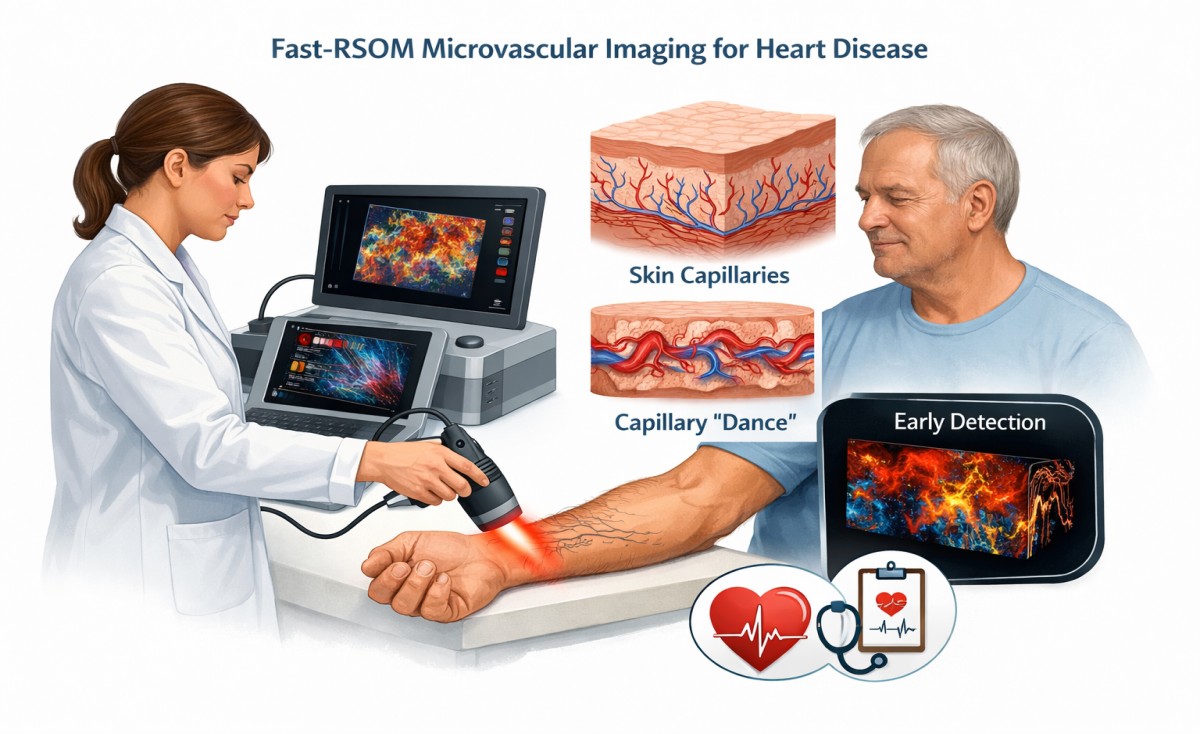
Berlin | January 24, 2026 : In a significant stride for cardiovascular health, researchers at Helmholtz Munich and the Technical University of Munich (TUM) have developed a groundbreaking imaging technology capable of detecting early microvascular markers of heart disease through a simple, non-invasive skin scan.
This innovation, known as fast-RSOM (Raster-scan Optoacoustic Mesoscopy), promises to revolutionize how we identify at-risk individuals, potentially enabling life-saving interventions long before traditional symptoms manifest.
The Science of Optoacoustics
The core of this technology lies in its ability to observe the “capillary dance”—the subtle, dynamic patterns of blood flow within the body’s smallest vessels. Unlike traditional imaging, fast-RSOM uses short pulses of laser light that cause tissues to expand and contract rapidly, generating high-frequency ultrasound waves. By capturing these “sounds” from the skin, the scanner creates high-resolution 3D images of the microvasculature without the need for radiation or contrast dyes.
Detecting the ‘Silent’ Warning Signs
The method focuses on the intricate network of capillaries located just beneath the skin’s surface. These vessels are highly sensitive to systemic changes. The scanner specifically identifies Microvascular Endothelial Dysfunction (MiVED)—a condition where these tiny vessels lose their ability to dilate and contract properly.
While traditional diagnostics like ECGs or angiograms identify issues once large arteries are already blocked, fast-RSOM provides a window into microscopic changes. Because the condition of the skin’s microvessels often mirrors the health of those supplying the heart, a forearm scan can reveal the “silent” progression of cardiovascular disease caused by smoking, high blood pressure, or diabetes.
A New Era of Preventative Cardiology
The implications for preventative medicine are profound. Heart disease remains a leading cause of mortality worldwide, largely because it is often diagnosed too late. This portable technology could soon become a staple in primary care clinics, moving the needle from reactive treatment to proactive prevention.
Imagine a routine check-up where a five-minute skin scan alerts a physician to impending cardiovascular risk years before a heart attack occurs. By identifying MiVED early, clinicians can implement personalized lifestyle modifications or targeted medications, aligning perfectly with the goals of precision medicine.
The Future of Universal Screening
As researchers refine the predictive accuracy of fast-RSOM, they are exploring its applications for other systemic conditions, such as chronic kidney disease and peripheral artery disease. This scientific advancement marks a pivotal moment in the global effort against heart disease, making early detection universally accessible and preventative measures more effective for millions of individuals across the globe.
