
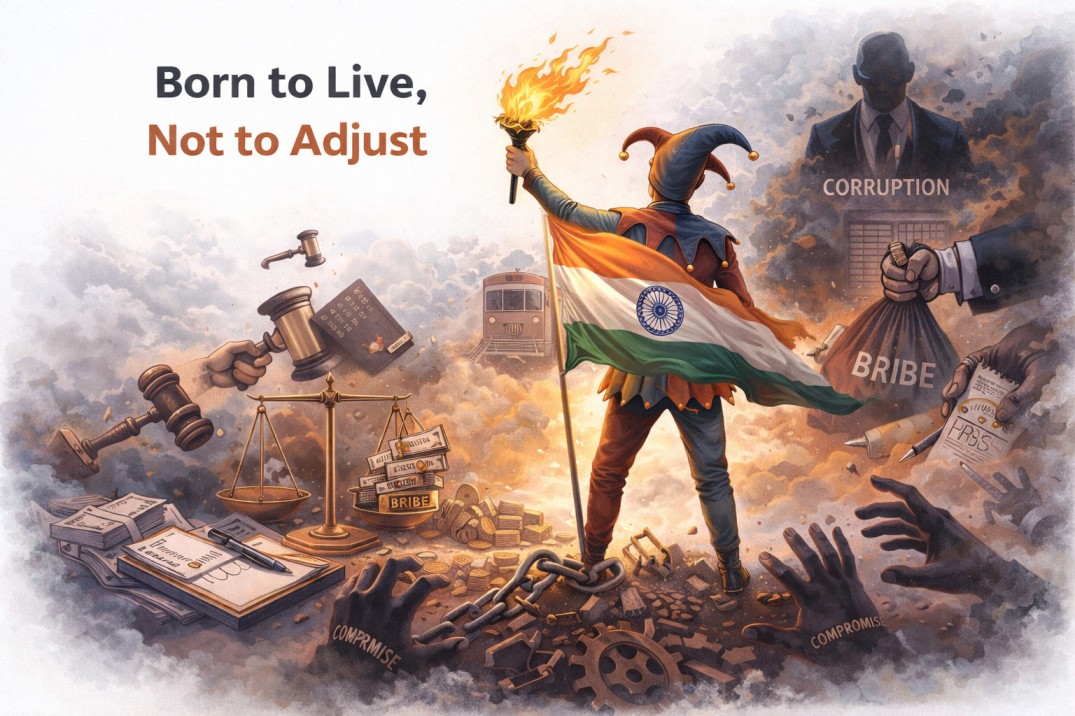
A nation that normalises compromise postpones dignity itself
Boris Pasternak, the Russian poet and novelist who endured the suffocating grip of Soviet authoritarianism, was not merely a literary genius but a moral witness to the decay of human freedom under oppressive systems. His words carried the weight of lived resistance. In his reflections, he warned: “In every generation there has to be some fool who will stand up to power.” And in another, he reminded humanity: “Man is born to live, not to prepare for life.”
These lines, though born in a different era, pierce sharply into the realities of India today—where corruption has ceased to be an exception and has instead hardened into a way of life across politics, judiciary, revenue, railways, police, education, and even the non-governmental sphere. It is worth recalling that Pasternak was awarded the Nobel Prize for Literature in 1958, yet the Soviet government refused to allow him to receive it—an act that itself symbolised the fear of truth when confronted by moral courage.
Corruption in India is no longer a scandal whispered in corners; it is a daily humiliation endured by ordinary citizens. Politics is often criticised as resembling a marketplace, where contracts, favours, and funding appear to shape policy. The judiciary—long regarded as the citizen’s final refuge—sometimes faces pressures that risk eroding public confidence. Revenue departments are routinely accused of delays unless payments are made, with citizens alleging that files, land records, and claims move faster through informal channels. Railways and infrastructure projects, lifelines for millions, have at times been shadowed by allegations of irregular tenders and compromised safety. The police, entrusted with protection, are sometimes perceived as coercive, leaving citizens feeling compelled to pay for relief or fearful of authority’s misuse.
Education, perhaps the most tragic victim, increasingly appears to teach adjustment over integrity—where admissions, examinations, and appointments are widely perceived to be influenced rather than earned. At this juncture, the warning of B. R. Ambedkar becomes unavoidable:
“A Constitution is as good as the men who implement it; if they are corrupt, the Constitution cannot save society.”
The decay, therefore, is not merely institutional; it is moral. Laws exist, safeguards exist, constitutions exist—but their spirit collapses when compromise replaces conscience.
In such a climate, Pasternak’s “fool” is not a romantic dreamer; he is a moral necessity. He is the whistleblower who exposes scams and loses his career, the officer who refuses to sign forged documents, the judge who defies political pressure, the teacher who refuses to sell marks. Society mocks them as naïve or impractical, yet history proves a hard truth: without such inconvenient voices, power inevitably degenerates into predation. A corrupt system is comfortable with wrongdoers; it is threatened only by honest people. The fool unsettles the comforting consensus that “nothing can change.” He reminds us that corruption survives not only because of powerful offenders, but also because of the silence of respectable beneficiaries.
For the citizens, corruption is not abstract—it is lived humiliation. Bribes are sanitised as speed money, favouritism is rebranded as networking, and silence is celebrated as practical wisdom. This culture of adjustment slowly erodes dignity. Here, Pasternak’s second insight becomes revolutionary: if man is born to live, then a system that forces him to endlessly prepare, compromise, and negotiate for his basic rights is fundamentally anti-human. Life becomes a postponed dream—a continuous bargain with indignity. Decades are spent managing the system instead of living freely within it.
The rare dissenter who refuses compromise is dangerous not because he holds power, but because he exposes its nakedness. Every refusal, every exposure, every act of dissent weakens the strongest fortress of corruption—the belief that resistance is futile. Systems may crush individuals, but they cannot erase the examples those individuals leave behind. Their courage becomes a seed of memory and hope, proof that moral freedom can still exist even in dark times.
Pasternak’s words ultimately confront our age with a brutal question: are we content merely to survive within corrupt systems, or are we willing to live as moral beings? To live, as he meant it, is to refuse surrender to compromise and moral postponement. A society without fools may function efficiently for a while, but it will rot silently from within. A society that still produces them, however, retains hope—even when corruption appears total.
Systems fall, regimes change, institutions decay—but the quiet courage of the so-called fool remains the only enduring investment in a truly liveable future.
