
Balancing Compassion, Strategy, and Rivalry with China
Editorial
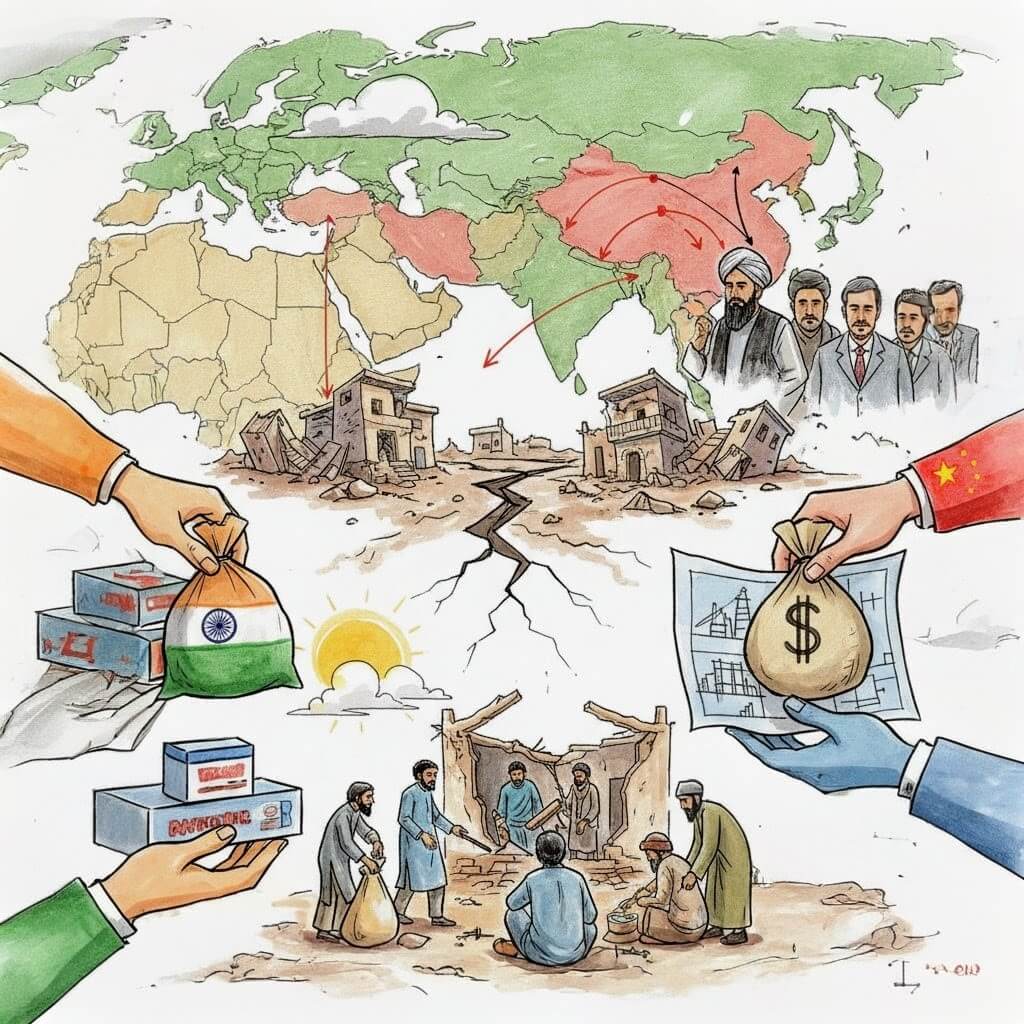
When a powerful earthquake struck northern Afghanistan earlier this week, leaving dozens dead and hundreds injured, India was among the first nations to act. Within hours, External Affairs Minister S. Jaishankar reached out to his Afghan counterpart, Amir Khan Muttaqi, conveying condolences and promising urgent humanitarian assistance. Shipments of food, medicines, and relief materials were swiftly dispatched, reinforcing India’s position as a dependable and compassionate partner in the region.
Yet this move goes far beyond mere humanitarian outreach. It is a calculated and timely effort to fill the strategic void left by the withdrawal of NATO forces from Afghanistan—a vacuum that China is increasingly eager to occupy. New Delhi’s rapid response signals not only empathy but intent: India is determined to remain visibly engaged in Afghanistan’s stability and reconstruction, countering China’s expanding influence across South and Central Asia.
India’s long-standing relationship with Afghanistan rests on decades of developmental projects—roads, schools, hospitals, and scholarships—that built deep goodwill among ordinary Afghans. Though the Taliban’s return to power in 2021 altered the diplomatic landscape, India has cautiously maintained engagement, focusing on humanitarian and technical cooperation while avoiding political endorsement of the regime. The earthquake response is an extension of this delicate balance: a gesture of solidarity that also serves strategic continuity.
Earlier this year, Amir Khan Muttaqi visited New Delhi, marking the most significant diplomatic engagement between the Taliban administration and India since 2021. The visit was not symbolic alone—it led to India upgrading its technical mission in Kabul, effectively restoring near-normal diplomatic functioning. The dialogue also coincided with growing tension between Afghanistan and Pakistan, which accused each other of border violations and cross-border militancy.
These recent strains have quietly tilted Kabul’s stance. Afghan leaders have made unusually forthright remarks about Islamabad, suggesting that Afghanistan has “five other neighbours who are all happy with us,” a clear indication that India now figures prominently in Kabul’s diplomatic calculus. This emerging friction presents India with a strategic opportunity to regain space once dominated by Pakistan’s influence.
Meanwhile, Beijing has wasted no time in signalling its readiness to assist Afghanistan as well. Chinese officials publicly offered aid and reconstruction support almost simultaneously with India’s announcements. For China, the interest in Afghanistan is deeply pragmatic: stability on its western frontier, access to mineral resources, and inclusion in the Belt and Road Initiative’s corridor through Central Asia. Beijing sees Afghanistan as both a potential security risk and a lucrative gateway—an assessment that drives its eagerness to expand engagement.
India, on the other hand, views Afghanistan through a broader lens of regional balance. A friendly, stable, and independent Afghanistan aligns with India’s strategic interests and curtails Pakistan’s leverage in the region. New Delhi’s quick aid delivery, including more than fifteen tons of essential supplies, serves not just immediate relief needs but a larger diplomatic message—that India, not China, is the reliable partner Afghanistan can count on in moments of crisis.
The broader context is one of shifting power equations. With the United States and NATO’s departure, Afghanistan’s reconstruction and governance are now shaped largely by regional actors—India, China, Pakistan, Iran, and Russia—each pursuing its own mix of security and economic interests. Humanitarian crises, like the recent earthquake, often become moments of testing and opportunity in this chessboard of regional diplomacy.
Pakistan, long accustomed to calling the shots in Kabul, now finds itself under strain. Its once-comfortable influence has weakened amid cross-border tensions and economic turmoil at home. The Taliban government’s increasingly assertive tone toward Islamabad, paired with its warm interactions with India, signals a realignment that would have seemed unlikely only a few years ago.
For New Delhi, this changing equation requires both speed and subtlety. While it seeks to support Afghanistan’s people, India must also guard against being drawn into the country’s internal politics or legitimising a regime still viewed with scepticism by much of the world. At the same time, any hesitation or delayed response risks ceding ground to Beijing, whose financial muscle and infrastructure diplomacy are far more aggressive.
The immediate task remains humanitarian—rebuilding homes, hospitals, and livelihoods shattered by the quake. But the larger contest is for influence: who will shape Afghanistan’s post-Western era. India’s decisive and empathetic approach, if sustained, can reaffirm its historic ties and reinforce its regional stature.
In contrast, a sluggish or symbolic effort could see China swiftly filling the gap with infrastructure promises and investment pledges. The true outcome will depend on consistency and commitment. In Afghanistan today, relief work doubles as diplomacy—and the nation that acts with both compassion and conviction will command the future of this troubled yet strategic crossroads of Asia.
