
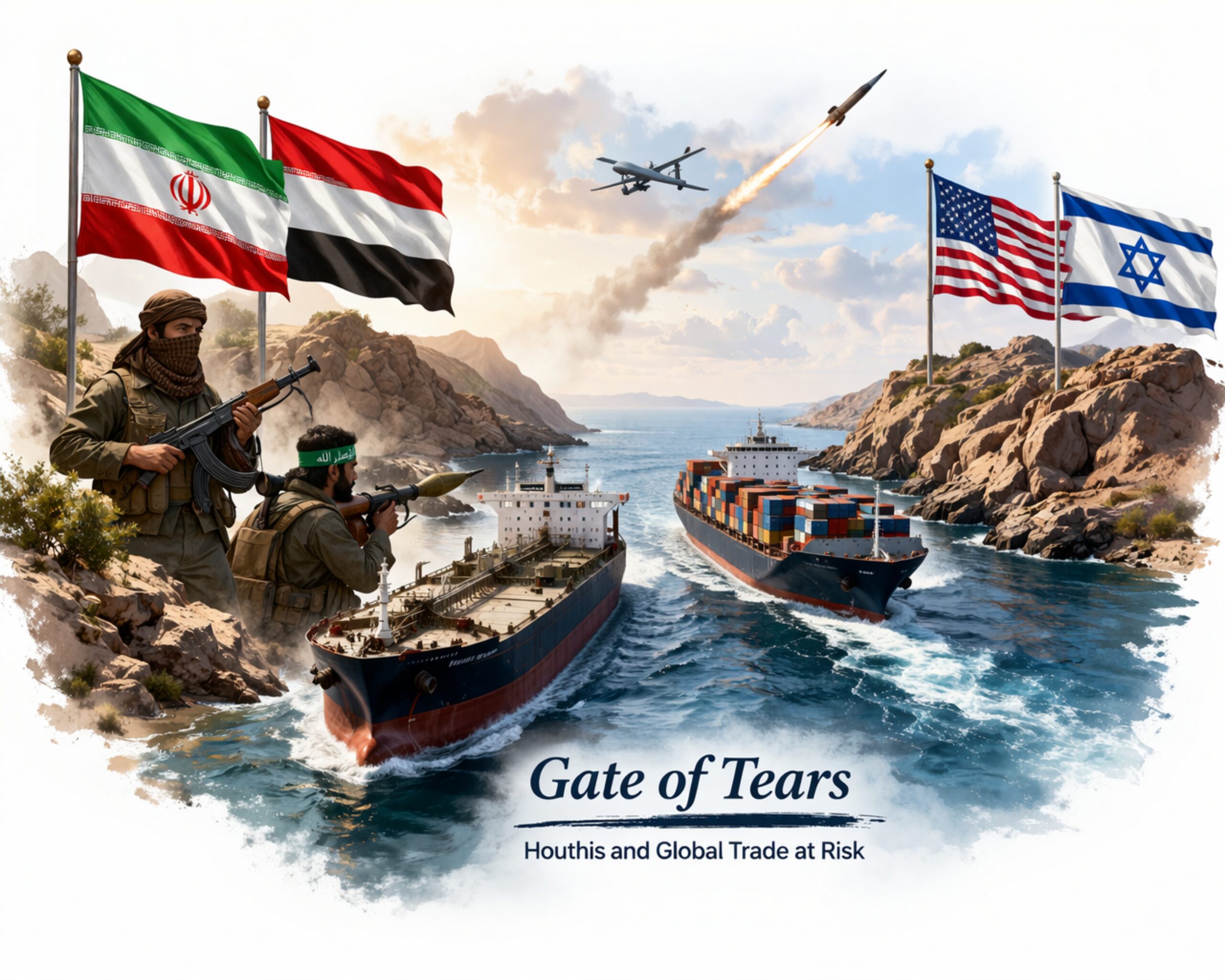
There are moments in history when geography ceases to be a silent spectator and instead becomes the central actor shaping global events. The Bab al-Mandeb Strait—often referred to as the “Gate of Tears”—is emerging as one such defining point, where a narrow maritime corridor is beginning to influence decisions, markets, and anxieties across continents.
At first glance, it may appear to be just another waterway on the world map. Yet, its strategic importance lies in its position. Acting as a crucial link between the Indian Ocean and the Red Sea, and ultimately connecting to the Suez Canal, this passage forms one of the fastest and most efficient trade routes between Asia and Europe. Every day, oil tankers and cargo vessels pass through this slender stretch, carrying not just commodities but the continuity of global trade itself.
For much of the recent geopolitical discourse, attention has been firmly fixed on the Strait of Hormuz. However, as the Middle East conflict deepens and widens, the Bab al-Mandeb Strait is steadily entering the strategic spotlight. What was once considered a secondary concern is now being viewed as a potential flashpoint with far-reaching consequences.
The situation has been further complicated by the involvement of Yemen’s Houthi forces, who are aligned with Iran. Their entry into the conflict has added a new layer of unpredictability. Recent missile launches and threats, even if currently limited in scope, signal a willingness to expand the theatre of confrontation. The concern is not merely about immediate damage but about what such actions imply for the future of commercial shipping.
The global economy, in many ways, runs on predictability—especially when it comes to energy supply. The Bab al-Mandeb Strait plays a vital role in this system, with a significant portion of the world’s oil shipments passing through it. Any disruption, even temporary, has the potential to create cascading effects. Oil markets are particularly sensitive to such risks, and even the perception of instability can lead to price volatility.
If the situation escalates further, ships may be forced to take alternative routes, most notably around the southern tip of Africa. While this detour ensures continuity, it comes at a steep cost. Longer travel times translate into higher fuel consumption, increased freight charges, and delays across supply chains. These costs do not remain confined to the shipping industry—they ripple outward, eventually reaching businesses and consumers worldwide.
What makes the current scenario especially complex is the strategic calculus behind it. The Houthis, operating from Yemen’s Red Sea coastline, have both the geographic advantage and the technological means to disrupt maritime traffic. Their previous actions have already demonstrated their capacity to target vessels, creating an environment of uncertainty that discourages free movement through the region.
From a broader perspective, this is not just about a regional conflict spilling over. It reflects a more calculated approach to exerting influence. By targeting critical infrastructure such as shipping lanes, pressure can be applied without engaging in direct large-scale confrontation. It is a method of escalation that remains below the threshold of full-scale war, yet carries significant global consequences.
This calibrated approach, however, is fraught with risk. Strategic restraint can quickly give way to unintended escalation, especially in a region where multiple actors with competing interests are involved. The presence of international military bases in nearby areas underscores just how sensitive and closely watched this corridor is.
Should the Bab al-Mandeb Strait face a serious disruption, the impact would extend far beyond the immediate region. Oil prices could spike sharply, shipping costs would rise, and inflationary pressures would intensify across economies already grappling with uncertainty. Supply chains—still recovering from past disruptions—could once again find themselves under strain, affecting industries ranging from manufacturing to agriculture.
In an extreme scenario, the imbalance between energy supply and demand could become so pronounced that consumption patterns might need to adjust drastically. Such a shift would echo the conditions seen during global lockdowns, when economic activity slowed and energy demand fell sharply. The very thought of such a regression highlights the gravity of the situation.
For now, the Bab al-Mandeb Strait remains open, and global trade continues to flow. Yet, beneath this surface of normalcy lies a growing sense of unease. The longer tensions persist, the greater the likelihood that this narrow passage could transform from a strategic asset into a critical vulnerability.
In the end, it is often these quiet, narrow corridors that shape the course of global history. Not with sudden noise, but with gradual pressure—until the world is compelled to pay attention.
