
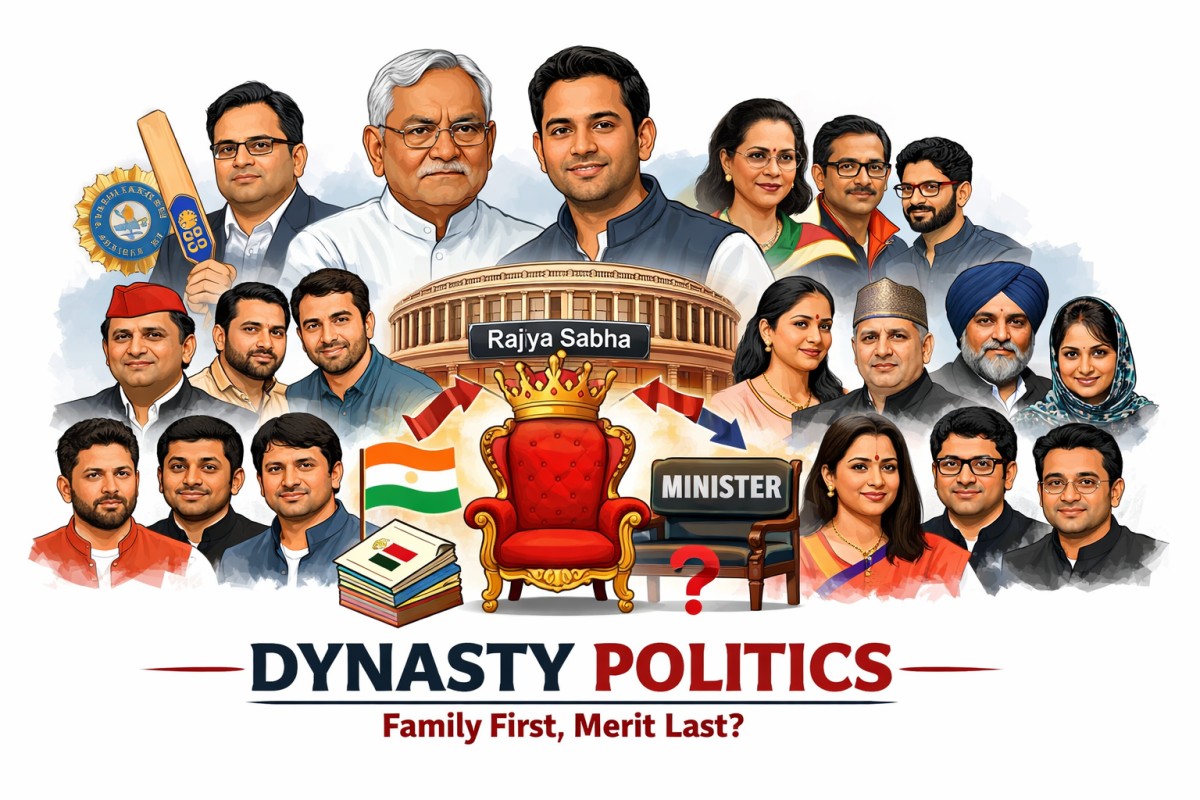
The above image is an illustrative representation, created with AI and does not depict actual individuals or events.
Indian politics has once again been pulled into a familiar and uncomfortable debate: the growing grip of dynasty politics. The latest political development involving Nitish Kumar has reignited criticism across the political spectrum. As the veteran Bihar leader reportedly moves toward a role in the Rajya Sabha, political circles are abuzz with speculation that the shift could pave the way for the political entry of his son.
For decades, many parties—especially those in opposition—have sharply criticised the Nehru–Gandhi family and leaders like Rahul Gandhi for promoting family-based leadership. Yet the unfolding events have exposed a deeper truth: dynasty politics is no longer confined to a single party. It has spread across almost every ideological line in the country.
Critics argue that the pattern is painfully predictable. A senior leader gradually shifts to a national role or ceremonial position, leaving behind a carefully prepared political space for a son or daughter. Party structures often adapt quietly, and soon the next generation emerges as a candidate, legislator, minister, or organisational leader.
The phenomenon is visible across regions and parties. In Maharashtra, the Uddhav Thackeray family represents one of the most prominent political dynasties. His son Aditya Thackeray quickly rose through the ranks and became a minister in the state government. Meanwhile, the parallel Thackeray lineage led by Raj Thackeray is preparing its own next generation, with Amit Thackeray increasingly visible in party affairs.
The Pawar family offers another example of inherited political influence. Supriya Sule, daughter of veteran leader Sharad Pawar, has long served as a Member of Parliament, while Sunetra Pawar has also entered electoral politics.
In Uttar Pradesh, the Akhilesh Yadav represents the continuation of the political legacy of Mulayam Singh Yadav. Similarly in Bihar, the Tejashwi Yadav and Tej Pratap Yadav have inherited the political mantle of their father Lalu Prasad Yadav.
In Tamil Nadu, the leadership of the Dravida Munnetra Kazhagam is another example of generational succession. Chief Minister M. K. Stalin followed his father M. Karunanidhi, and now Stalin’s son Udhayanidhi Stalin has entered the cabinet, signalling yet another generational shift.
In Jammu and Kashmir, political lineage has long shaped leadership. Omar Abdullah is the son of Farooq Abdullah and the grandson of Sheikh Abdullah. Similarly, Mehbooba Mufti carried forward the political legacy of her father Mufti Mohammad Sayeed.
Punjab politics also reflects this pattern. Sukhbir Singh Badal inherited leadership of the Shiromani Akali Dal from his father Parkash Singh Badal.
In Telangana, the political family of K. Chandrashekar Rao dominates the Bharat Rashtra Samithi. His son K. T. Rama Rao and daughter K. Kavitha both occupy significant political roles.
Another example comes from Bihar itself, where Chirag Paswan stepped into national politics after the death of his father Ram Vilas Paswan.
Even beyond immediate parent-child relationships, family connections often open political doors. Abhishek Banerjee is the nephew of West Bengal Chief Minister Mamata Banerjee. Pankaj Singh is the son of former Union Home Minister Rajnath Singh, while Jyotiraditya Scindia comes from the influential Scindia family, being the son of Madhavrao Scindia and grandson of Vijaya Raje Scindia.
The trend stretches further. Poonam Mahajan is the daughter of the late Pramod Mahajan. Bhavya Bishnoi is the son of Kuldeep Bishnoi and grandson of former Haryana Chief Minister Bhajan Lal. Parvesh Verma is the son of former Delhi Chief Minister Sahib Singh Verma.
Dynasty influence is not limited to legislatures alone. In Indian cricket administration, Jay Shah, the son of Amit Shah, rose rapidly from serving as secretary of the Board of Control for Cricket in India to his present position as chairman of the International Cricket Council, one of the most influential roles in world cricket.
These examples underline a larger truth: dynasty politics has become a structural feature of Indian democracy rather than an exception. Political parties frequently argue that voters ultimately decide who wins elections. Yet critics point out that the first opportunity to contest—often the most difficult barrier in politics—is usually reserved for those with famous surnames.
For millions of young Indians aspiring to enter public life, the system increasingly appears unequal. Party tickets, organisational posts, and visibility often seem to circulate within the same families, creating what observers call a “closed political ecosystem”.
Against this backdrop, the debate sparked by Nitish Kumar’s political manoeuvre is less about one leader or one party. It has become a mirror reflecting a deeper national dilemma: whether Indian democracy is evolving into a system driven by public participation—or quietly drifting toward hereditary power.
Until political parties demonstrate that leadership can emerge from merit rather than lineage, the charge of dynasty politics will continue to haunt every corner of India’s political landscape.
