
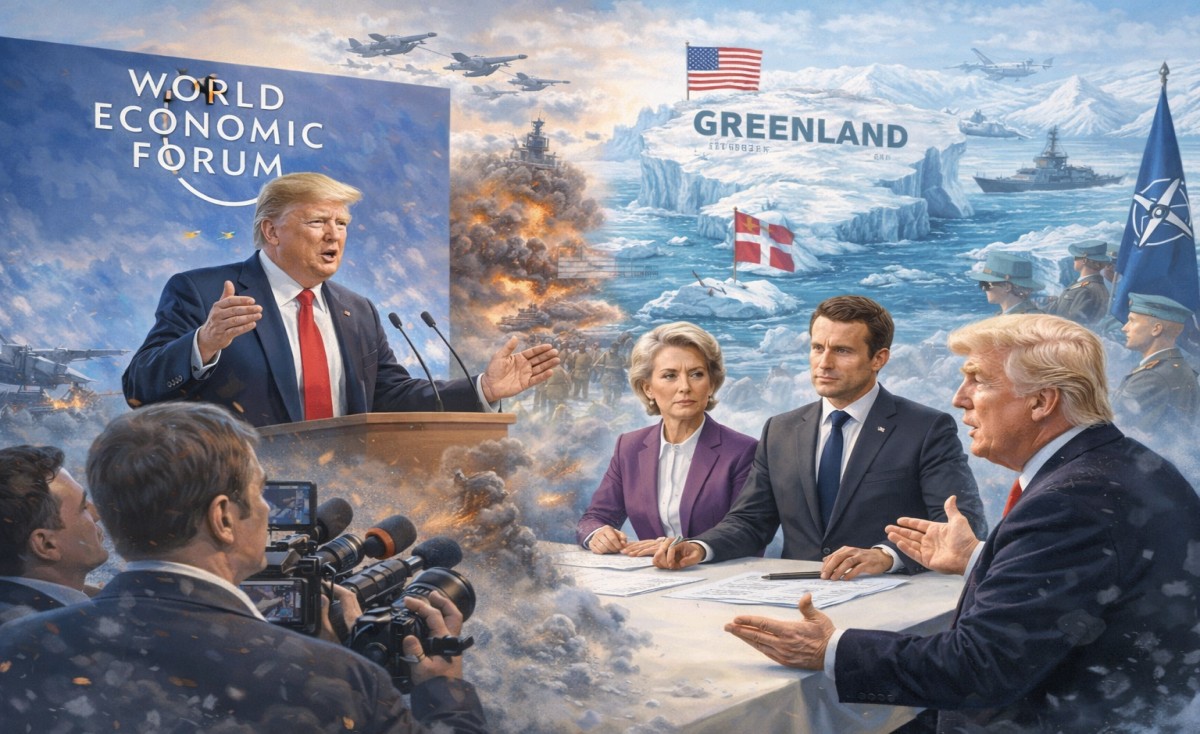
Disclaimer: Image is a symbolic illustration created for representational purposes and does not depict real events or exact moments.
Davos, Switzerland, January 21, 2026 : Former US President Donald Trump has reignited global debate on Washington’s role in world affairs by projecting confidence on a possible settlement of the Ukraine war while simultaneously hardening his stance on Greenland, a move that has unsettled European allies and sharpened transatlantic tensions.
Speaking on the sidelines of the annual meeting of the World Economic Forum in Davos, Trump said he believed the United States was “reasonably close” to brokering an understanding to halt the fighting between Russia and Ukraine. He argued that both Russian President Vladimir Putin and Ukrainian President Volodymyr Zelenskyy were aware of the human cost of prolonging the conflict and suggested that continued hostilities made little sense given the scale of casualties and destruction. Trump maintained that the war could and should be stopped, stressing that drones and modern warfare were claiming thousands of lives each week.
At the same time, Trump’s remarks on Greenland have sent shockwaves across Europe. He reiterated that the strategically located Arctic territory was critical to US national and international security, pointing to its geographic position and long-term economic and military value. Trump framed Greenland as an asset that Denmark struggles to maintain financially, suggesting that Washington’s interest was rooted in security considerations rather than territorial ambition.
This posture has pushed relations with European partners toward a breaking point. Several European officials have privately and publicly indicated that Trump’s hardline approach leaves little room for compromise, with some arguing that retaliation, not accommodation, may be the only viable response if pressure on Denmark intensifies. Concerns have also emerged within NATO capitals that such disputes could weaken alliance unity at a time when the Ukraine conflict has already placed extraordinary strain on Europe’s security architecture.
Trump dismissed fears of a wider global conflict, insisting that the world was not heading toward a third world war and claiming that firm US intervention had prevented escalation. He contrasted this with what he described as weaker leadership alternatives, arguing that indecision would have led to far graver outcomes in Ukraine and beyond.
Together, Trump’s comments in Davos underscore a dual-track message: confidence in his ability to force a breakthrough on the Ukraine war, paired with an unapologetic assertion of US strategic interests in the Arctic. While supporters see this as decisive leadership, critics warn that the Greenland issue risks deepening rifts with Europe just as cooperation is most needed to manage the fallout from the war in Ukraine.
